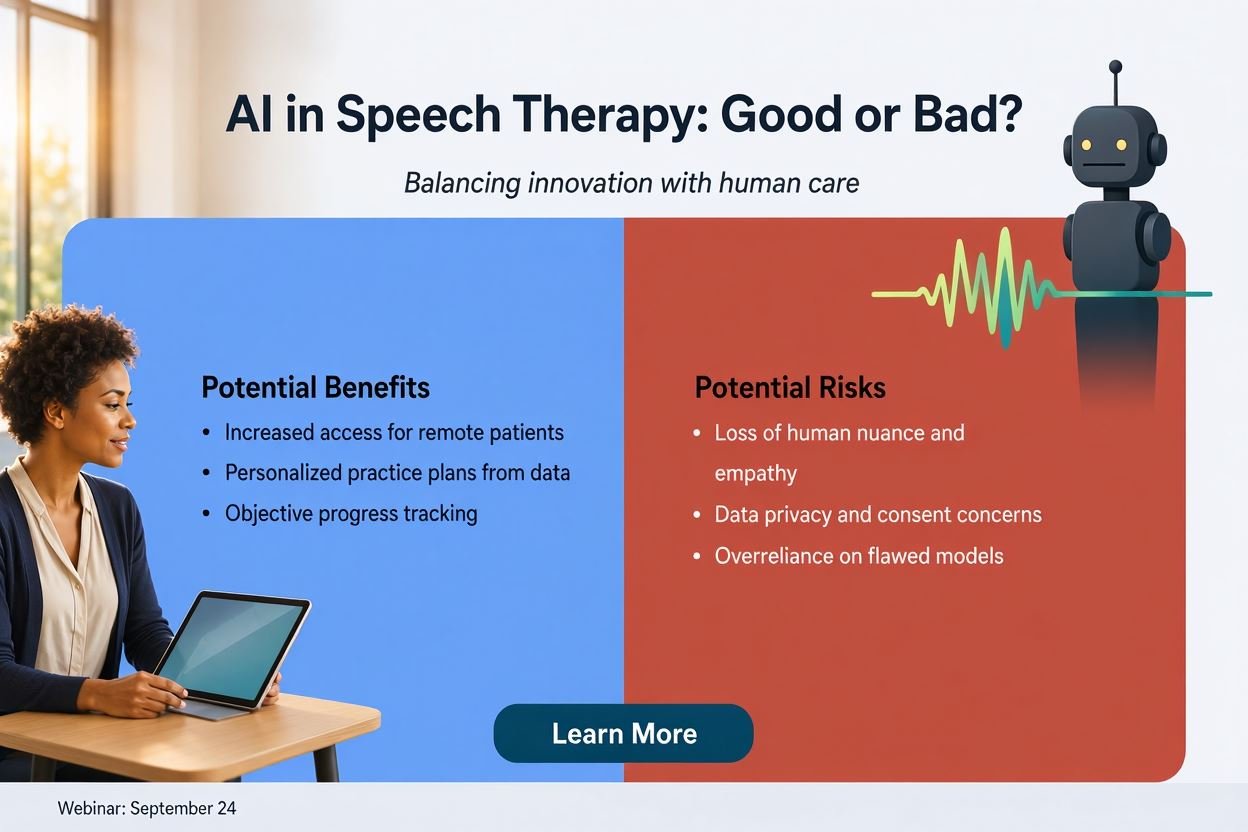
Artificial Intelligence, commonly known as AI, is becoming an important part of modern healthcare and digital technology. Speech and language rehabilitation is also beginning to benefit from AI-powered tools, speech recognition systems, digital exercises and personalized practice platforms.
This raises an important question: Is AI good or bad for speech therapy?
The answer is not simply "good" or "bad". AI can be a powerful supporting technology when it is designed and used appropriately. At the same time, AI has important limitations and should not be treated as a replacement for professional clinical assessment or the expertise of a qualified Speech-Language Pathologist (SLP).
What Is AI in Speech Therapy?
AI in speech therapy refers to the use of artificial intelligence technologies to support activities related to speech, language, communication and rehabilitation.
Depending on the technology, AI may be used for speech recognition, language analysis, personalized exercises, automated feedback, progress tracking, communication support and other digital rehabilitation tasks.
AI can process large amounts of information and identify patterns that may be difficult to analyze manually. However, identifying a pattern does not automatically mean that AI understands the complete clinical situation of a patient.
How Is Artificial Intelligence Used in Speech Therapy?
Speech Recognition
AI-powered speech recognition can convert spoken language into text and may help analyze certain characteristics of speech.
This can provide useful information during digital speech practice, although recognition accuracy may vary depending on the speaker and the type of communication difficulty.
Personalized Practice
AI can potentially help organize exercises according to a user's performance and practice history.
This can make digital practice more flexible instead of providing exactly the same activity to every user.
Language Exercises
AI can assist in generating or organizing activities involving words, sentences, comprehension and language practice.
These activities can be particularly useful when combined with clinician-selected therapy goals.
Progress Tracking
Digital systems can record exercise attempts, completion and other practice information.
Such information may help clinicians understand how consistently a patient is participating in structured home practice.
Speech Practice Feedback
Some AI-based systems can provide automated feedback during speech or language practice.
Automated feedback can provide additional practice opportunities, but it should not automatically be interpreted as a clinical diagnosis.
Digital Exercise Creation
AI can help therapists create variations of structured activities, examples, prompts and practice material.
The SLP should review and adapt generated material before using it with a patient.
Benefits of AI in Speech Therapy
When used responsibly, AI can provide several potential advantages for speech-language rehabilitation.
1. More Opportunities for Practice
One of the biggest potential advantages of digital technology is the ability to provide additional practice outside scheduled therapy sessions.
A patient may be able to practice selected words, sounds, pictures or sentences repeatedly according to an exercise plan.
2. Personalized Exercises
AI can potentially help adapt the difficulty or type of exercise based on previous performance.
Personalization is important because two patients with the same diagnosis may have very different communication abilities.
3. Faster Exercise Preparation
AI tools can assist SLPs in preparing examples, practice materials and variations of activities.
This may reduce some repetitive preparation work and allow clinicians to spend more time on assessment, therapy and patient interaction.
4. Better Digital Practice Tracking
Digital platforms can record exercise attempts and practice activity. This information can help provide a clearer picture of how much structured practice is being completed.
5. Accessibility and Convenience
Digital speech therapy tools can potentially make selected practice activities available beyond the clinic, including home-based practice.
This can be especially useful when travel, distance or scheduling makes frequent in-person sessions difficult.
6. Support for Hindi and Multilingual Practice
Language is an important part of effective communication rehabilitation. Digital tools can be designed around the languages that patients actually use in everyday life.
For Hindi-speaking individuals, exercises may include Swar Abhyas, Shabd Abhyas, picture identification, word-to-picture association and sentence practice.
Disadvantages of AI in Speech Therapy
AI also has limitations. Understanding these limitations is essential before using artificial intelligence in clinical speech and language rehabilitation.
1. AI Does Not Understand the Complete Patient
A patient is much more than a collection of speech recordings, scores or exercise results.
Communication is influenced by cognition, emotions, environment, family support, motivation, culture, language background and many other factors.
2. Speech Recognition Can Be Inaccurate
Speech recognition systems may perform differently depending on speech clarity, accent, language, background noise, speaking rate and the characteristics of the communication disorder.
A system that works well for typical speech may not always accurately recognize severely impaired speech.
3. Risk of Inappropriate Exercises
AI can generate information or activities that appear reasonable but may not be appropriate for a particular patient.
This is why AI-generated therapy content should be reviewed by a qualified professional before being used clinically.
4. Privacy and Data Security
Speech and health-related information can be sensitive. Digital systems that collect recordings, patient information or therapy data must consider privacy, security and appropriate handling of personal information.
5. Overdependence on Technology
Technology should support therapy rather than become the entire therapy process.
Communication is fundamentally human. Eye contact, empathy, motivation, counseling, family interaction and therapeutic relationships cannot be fully replaced by software.
AI in Aphasia Therapy
Aphasia can affect speaking, understanding, reading, writing and word retrieval. AI-supported digital tools may provide additional opportunities to practice some of these skills.
Depending on the individual's needs, digital activities may include:
- Picture naming
- Word retrieval practice
- Word-to-picture matching
- Sentence completion
- Word comprehension
- Reading practice
- Functional communication practice
- Repeated language practice
However, aphasia is not the same for every patient. The appropriate exercises should therefore be selected according to the individual's language profile and therapy goals.
AI in Dysarthria Therapy
Dysarthria is a motor speech disorder that can affect speech clarity, loudness, rate and articulation.
AI and speech recognition technologies may help provide additional opportunities for speech practice or assist in analyzing selected aspects of spoken communication.
However, automated systems may have difficulty understanding severely unclear speech. Clinical assessment remains important when determining the underlying speech characteristics and appropriate treatment strategies.
AI and Speech-Language Pathologists
The future of AI in speech therapy should not be viewed as AI versus SLP.
A more useful way to think about the future is: AI + SLP.
AI vs Human Speech Therapy
| Area | AI / Digital Tools | Speech-Language Pathologist |
|---|---|---|
| Repetition | Can provide repeated digital practice | Determines what should be practiced |
| Personalization | Can adapt selected digital activities | Creates clinically appropriate individualized goals |
| Speech Analysis | Can process selected speech information | Interprets speech within the clinical context |
| Emotional Support | Limited | Provides human interaction and counseling |
| Clinical Judgment | Cannot replace professional judgment | Essential for assessment and treatment planning |
| Home Practice | Can provide digital exercises | Can design and monitor the exercise plan |
Can AI Replace Speech-Language Pathologists?
This is one of the most common questions surrounding AI in speech therapy.
AI may automate certain repetitive tasks, but replacing an SLP completely is a very different matter.
Speech-language rehabilitation involves assessment, individualized goal setting, clinical reasoning, counseling, motivation, family education, observation and continuous adjustment of treatment.
These responsibilities require understanding the individual beyond what can be captured by an algorithm.
How SLPs Can Use AI Responsibly
Speech-Language Pathologists can consider AI as a supporting technology rather than an autonomous therapist.
- Use AI to generate ideas and exercise variations.
- Review AI-generated material before giving it to patients.
- Use digital tools for additional home practice.
- Track patient participation where appropriate.
- Protect patient privacy and sensitive information.
- Avoid relying on AI alone for diagnosis or clinical decisions.
- Combine technology with professional observation and patient-centered therapy.
AI for Home Speech Therapy Practice
One of the most promising applications of AI and digital technology is supporting structured practice outside the clinic.
A clinician can identify appropriate activities and the patient can then practice them regularly using a digital platform.
Depending on the patient's goals, home practice may involve:
- Swar practice
- Word practice
- Sentence practice
- Picture identification
- Word-to-picture matching
- Reading activities
- Speech repetition
- Melodic and rhythm-based activities
Digital practice can provide repetition, but the quality of the exercise matters more than simply increasing the number of repetitions.
How VaaniSetu Can Support Digital Speech Practice
VaaniSetu is designed to support structured Hindi speech and language practice for patients, caregivers and Speech-Language Pathologists.
The platform focuses on meaningful digital exercises that can complement professional rehabilitation and home practice.
Depending on the exercise package created for the patient, activities may include:
- Hindi Swar Abhyas
- Shabd Abhyas
- Sentence Practice
- Photo Identification
- Word-to-Photo Association
- Melodic and Rhythm-Based Exercises
- Cognitive Skill Activities
- Structured Exercise Packages
- Practice and Attempt Tracking
For SLPs, digital tools can help organize structured exercises and provide patients with additional opportunities for guided practice between professional sessions.
Technology Can Support Therapy. Humans Make It Meaningful.
Explore structured Hindi speech practice, digital exercises and patient-focused rehabilitation tools with VaaniSetu.
Visit VaaniSetu.inWhat Is the Future of AI in Speech Therapy?
AI is likely to become increasingly integrated into digital speech and language rehabilitation.
Future systems may become better at recognizing different speech patterns, supporting multilingual practice, analyzing large amounts of therapy data and creating more personalized digital exercises.
However, technological progress should be accompanied by responsible clinical use.
The goal should not be to automate everything. The goal should be to use technology where it genuinely improves access, efficiency, practice and patient engagement.
So, Is AI in Speech Therapy Good or Bad?
AI in speech therapy can be both useful and risky, depending on how it is used.
It can be good when it provides additional practice, supports clinicians, improves accessibility, organizes exercises and helps patients remain engaged.
It can become harmful when it is treated as a replacement for professional assessment, used without checking its recommendations, or allowed to make clinical decisions without appropriate human oversight.
Key Takeaways
- AI in speech therapy can provide useful digital support for patients and clinicians.
- AI can assist with speech recognition, exercise generation, personalization and practice tracking.
- AI may provide additional opportunities for aphasia, dysarthria and language practice.
- AI-generated exercises should be reviewed before clinical use.
- Speech recognition may not work equally well for all communication disorders.
- Patient privacy and responsible handling of speech data are important considerations.
- AI should support rather than replace the clinical role of Speech-Language Pathologists.
- The future of speech therapy is likely to involve collaboration between human expertise and technology.
Frequently Asked Questions
What is AI in speech therapy?
AI in speech therapy refers to the use of artificial intelligence technologies such as speech recognition, language processing, personalized digital exercises and automated analysis to support speech and language rehabilitation.
Is AI good for speech therapy?
AI can be useful when used as a supporting technology. It can provide additional practice opportunities, assist with exercise personalization, support progress tracking and help clinicians organize certain tasks. However, AI should not replace professional assessment and clinical decision-making.
Can AI replace a Speech-Language Pathologist?
AI should not be considered a replacement for a qualified Speech-Language Pathologist. Assessment, individualized treatment planning, counseling and clinical judgment require professional expertise and understanding of the individual patient.
How can AI help Speech-Language Pathologists?
AI may help SLPs with speech practice, speech recognition, exercise generation, documentation support, patient progress tracking, language activities and personalized digital practice.
Can AI help with aphasia therapy?
AI-based tools may support aphasia practice through activities such as word retrieval, picture naming, language exercises, sentence practice and personalized repetition. Activities should be selected according to the individual's communication profile and therapy goals.
Can AI help patients with dysarthria?
AI may support certain aspects of dysarthria practice, including speech recognition, communication practice and feedback. However, dysarthria is a complex motor speech disorder and appropriate exercises should be guided by an appropriately qualified professional.
What are the disadvantages of AI in speech therapy?
Potential disadvantages include inaccurate speech recognition, limited understanding of individual patient needs, privacy concerns, dependence on technology, inappropriate exercise recommendations and the risk of reducing therapy to automated practice without adequate clinical supervision.
Will AI change the future of speech therapy?
AI is likely to become an increasingly useful supporting technology in speech and language rehabilitation. The most useful future model is likely to combine AI-assisted tools with the clinical expertise, communication skills and judgment of Speech-Language Pathologists.
This article is intended for educational and informational purposes only. AI-based tools should not be used as a substitute for professional medical advice, speech-language assessment, diagnosis or individualized treatment. Speech-Language Pathologists and other appropriately qualified healthcare professionals should use their professional judgment when selecting and applying digital or AI-assisted tools. Do not start, stop or modify treatment based solely on information provided in this article.