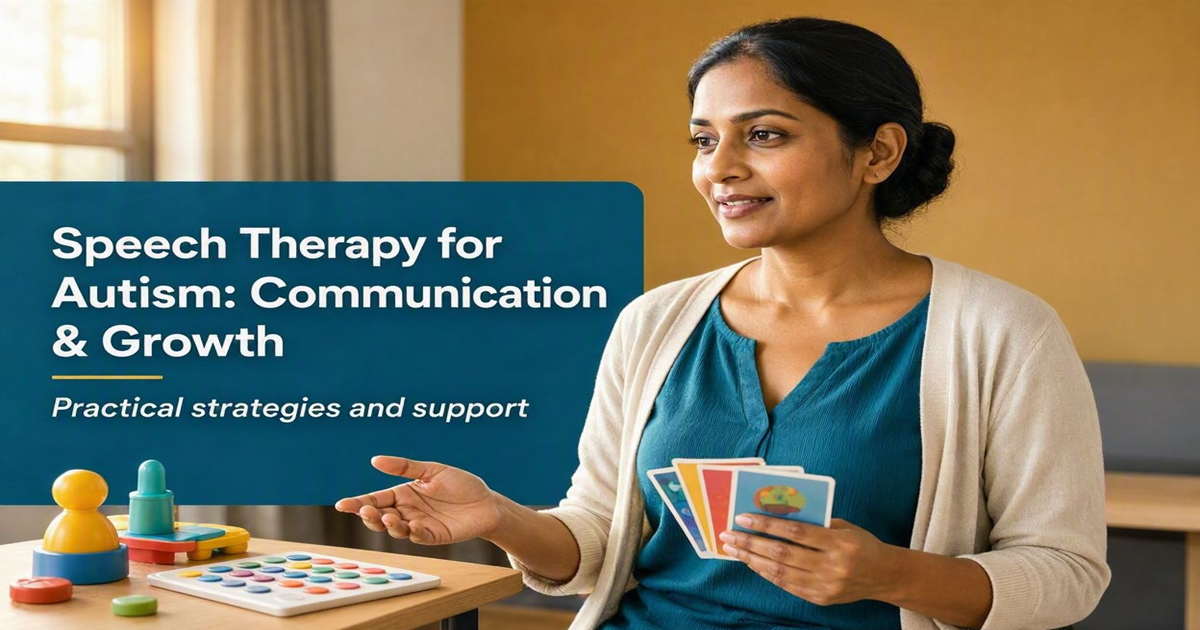
Communication looks different for every autistic child. Some children may speak in sentences but have difficulty using language socially. Others may use only a few words, repeat phrases, communicate mainly through gestures, or use little or no spoken language.
This is where a Speech-Language Pathologist (SLP) can play an important role. Speech therapy for autism is not simply about teaching a child to pronounce words. It can involve understanding language, expressing needs, participating in conversations, developing functional communication and finding communication methods that work for the individual child.
The most useful goal is not necessarily "more words." The goal is meaningful communication — helping the child communicate needs, choices, thoughts, feelings and interests as effectively as possible.
What Is Speech Therapy for Autism?
Speech therapy, more accurately called speech-language therapy, focuses on communication. For an autistic child, an SLP may work on speech, language, social communication and alternative ways of communicating.
Depending on the child, therapy may focus on:
- Understanding spoken language.
- Using words and sentences.
- Requesting objects or activities.
- Answering and asking questions.
- Following instructions.
- Taking turns during communication.
- Starting and maintaining interactions.
- Improving speech clarity when appropriate.
- Using gestures, pictures or AAC when needed.
Why Is Communication Support Important in Autism?
Communication allows children to participate in family life, school, play and everyday activities. When a child cannot easily communicate what they need or want, frustration can sometimes increase.
Supporting communication can help a child develop practical ways to express themselves and understand other people.
Expressing Needs
Helping a child communicate needs such as food, water, help, rest or preferred activities.
Making Choices
Supporting children in communicating what they want instead of relying only on adults to guess.
Social Interaction
Practising turn-taking, greetings, requesting, sharing attention and participating in interactions.
Functional Communication
Building communication skills that are useful in real situations at home, school and in the community.
Speech and Language Are Not the Same
Parents sometimes use "speech" and "language" interchangeably, but they describe different areas of communication.
Speech
Speech involves producing sounds and words. A child may have difficulty with speech clarity, sound production, voice or fluency.
Language
Language involves understanding and expressing meaning through words, sentences, gestures, symbols or other communication systems.
An autistic child may have difficulties in one area, several areas, or have a communication profile that does not fit a simple category. An SLP can assess the child's individual strengths and needs.
Common Communication Challenges in Autistic Children
Communication differences vary considerably. Some children may experience one or more of the following:
Limited Spoken Language
The child may use fewer words than expected or may not consistently use spoken language to communicate.
Repeating Words or Phrases
Some children repeat words or phrases they have heard. This may be called echolalia and can sometimes serve a communicative purpose.
Difficulty Answering Questions
A child may know words but find it difficult to understand or respond to certain questions.
Social Communication Differences
The child may have difficulty starting conversations, taking turns, maintaining topics or interpreting social communication.
Difficulty Communicating Needs
A child may struggle to communicate requests, choices, discomfort or the need for help.
Speech Clarity Difficulties
Some children may also have difficulty producing certain sounds or making their speech easy to understand.
Autism and Speech Delay: Are They the Same?
Autism and speech delay are not the same thing.
Some autistic children have delayed spoken language, while others develop spoken language at an expected pace but experience differences in social communication.
A child can also have a speech or language difficulty without being autistic. This is why a comprehensive developmental and communication assessment is important rather than assuming that every speech delay is caused by autism.
What If My Autistic Child Is Not Speaking?
Not speaking does not mean that a child has nothing to communicate.
Some children may communicate through gestures, pointing, facial expressions, pictures, signs, communication boards or electronic communication systems.
An SLP can help determine which communication methods may be appropriate and how to build functional communication around the child's existing abilities.
What Is AAC and How Can It Help?
AAC stands for Augmentative and Alternative Communication. It includes communication methods used to supplement or provide an alternative to spoken communication.
Examples can include:
- Gestures.
- Signs.
- Picture communication.
- Communication boards.
- Visual symbols.
- Speech-generating devices.
An SLP can help determine whether AAC may be useful for an individual child and how it can be incorporated into everyday communication.
Common Goals of Speech Therapy for Autism
Therapy goals should be individualized. Common goals may include:
Requesting
Helping the child communicate requests such as "water," "more," "open," "help" or preferred activities.
Following Instructions
Supporting understanding of everyday instructions and language used at home or school.
Vocabulary
Building useful vocabulary around people, objects, actions, places and everyday routines.
Sentence Development
When appropriate, supporting the development of phrases and sentences for functional communication.
Social Communication
Practising turn-taking, greetings, sharing information, asking questions and participating in conversations.
Speech Clarity
When speech production is a concern, an SLP may provide targeted speech-sound practice.
Simple Communication Activities Parents Can Try at Home
Parents can create communication opportunities throughout the day. Activities should be enjoyable, meaningful and appropriate for the child's abilities.
Choice Making
Offer two choices such as "apple or banana?" and allow the child to communicate their choice using speech, gesture, picture or another method.
Picture Naming
Use familiar pictures of family members, animals, objects and actions to encourage identification and communication.
Shared Reading
Look at simple picture books together and talk about objects, people, actions and events.
Turn-Taking Games
Simple games involving "my turn" and "your turn" can create opportunities for interaction and communication.
Everyday Routines
Use meals, bathing, dressing and playtime as natural opportunities to practise functional communication.
Songs and Rhymes
Familiar songs and rhymes can encourage participation, imitation and enjoyable vocal interaction.
Speech Therapy for Autistic Children in Hindi
Many Indian children grow up hearing Hindi along with English or another regional language. Communication support should take the child's actual language environment into account.
Parents do not necessarily need to stop speaking Hindi because their child is receiving speech therapy. Familiar language can provide meaningful opportunities for communication with parents, grandparents, siblings and other family members.
Hindi Communication Activities for Autistic Children
Depending on the child's goals, families can incorporate simple Hindi communication activities into everyday routines.
- Naming familiar objects such as पानी, गेंद, किताब and खाना.
- Identifying family members such as माँ, पापा, दादी and भाई.
- Choosing between two objects.
- Practising simple requests such as "पानी चाहिए।"
- Identifying actions such as खाना, पीना, सोना and खेलना.
- Building short functional sentences.
- Using pictures to support understanding and expression.
Why Visual Supports Can Be Helpful
Some children benefit from visual information alongside spoken instructions. Pictures, symbols, schedules and visual choices can make communication easier to understand and participate in.
For example, instead of only asking: "What do you want?" a parent might show two pictures representing two available choices.
Visual supports should be selected according to the child's needs. An SLP can help families decide which type of visual communication system is appropriate.
How VaaniSetu Can Support Communication Practice
VaaniSetu provides structured digital speech and language practice activities that can be incorporated into a child's communication routine.
Depending on the child's individualized practice plan, VaaniSetu can support activities such as:
- Picture identification.
- Word-to-picture association.
- Word practice.
- Sentence practice.
- Visual learning activities.
- Structured Hindi speech practice.
- Practice and attempt tracking.
The Role of Parents in Speech and Language Development
Parents are an important part of a child's communication environment. Everyday interactions provide many opportunities to practise communication naturally.
Talk During Daily Activities
Describe what you are doing while cooking, eating, travelling, bathing or playing.
Follow the Child's Interests
Use toys, activities and subjects that naturally attract your child's attention to create communication opportunities.
Give Communication Time
Allow your child enough time to process information and respond using their preferred communication method.
Celebrate Communication
Respond positively when your child communicates a need, choice, idea or feeling.
What Parents Should Avoid
- Do not force a child to repeat words continuously.
- Do not shame or punish communication differences.
- Do not assume that lack of spoken words means lack of understanding.
- Do not compare your child's communication development with another child's.
- Do not focus only on pronunciation when the child needs broader communication support.
- Do not remove an effective communication method simply because the child is not speaking yet.
When Should Parents Consult a Speech Therapist?
Parents can seek an SLP evaluation when they have concerns about communication, whether or not a child already has an autism diagnosis.
- ☑ Your child uses very few words or does not use spoken language.
- ☑ Your child has difficulty communicating basic needs.
- ☑ Your child has difficulty understanding everyday language.
- ☑ Your child repeats words or phrases without clear functional communication.
- ☑ Your child has difficulty participating in communication with family members or peers.
- ☑ Your child has difficulty with speech clarity.
- ☑ Your child becomes frustrated because communication is difficult.
- ☑ Your child's communication skills appear to have stopped progressing.
- ☑ Your child loses previously acquired communication skills.
What Happens During an Autism Speech-Language Assessment?
An SLP may evaluate several areas of communication rather than looking only at the number of words a child can say.
- Understanding of spoken language.
- Expressive language.
- Functional communication.
- Social communication.
- Speech sound production when relevant.
- Gestures and non-verbal communication.
- Use of pictures or other communication supports.
- Communication during play and everyday activities.
The resulting goals should be practical and meaningful for the child and family.
Functional Communication Is More Important Than Memorized Words
A child may be able to name many objects but still have difficulty communicating what they actually want.
For example, learning the word "water" is useful. But being able to communicate: "मुझे पानी चाहिए।" or using a picture, gesture or communication device to request water may be more meaningful in an everyday situation.
"Can my child communicate what they need, want, understand, feel and think?"
How Do Parents Know If Communication Is Improving?
Progress does not always mean suddenly saying many new words.
Positive changes may include:
- More intentional communication.
- More consistent requesting.
- Better understanding of instructions.
- Increased use of gestures or pictures.
- More spontaneous words.
- Longer or more meaningful phrases.
- Better turn-taking.
- More successful communication during everyday routines.
Tracking these changes can help families and professionals understand which communication strategies are working.
Speech Therapy and Communication at School
Communication skills are important not only at home but also at school. Children may need to communicate with teachers, classmates and caregivers.
Depending on the child's needs, communication goals may include:
- Asking for help.
- Answering simple questions.
- Making choices.
- Participating in classroom routines.
- Communicating with peers.
- Following classroom instructions.
Collaboration between parents, educators and communication professionals can help create more consistent opportunities for communication.
Common Myths About Autism and Speech Therapy
Myth: "Every Autistic Child Must Learn to Speak"
Spoken communication can be an important goal when appropriate, but communication can also involve AAC, gestures, pictures, signs and other methods.
Myth: "AAC Stops Children From Talking"
AAC can provide children with a way to communicate when spoken communication is difficult. Its use should be individualized and guided by communication needs.
Myth: "Speaking Two Languages Causes Autism"
Autism is not caused by bilingual or multilingual communication. Families can continue using familiar languages in everyday interactions.
Myth: "More Words Always Mean Better Communication"
Functional communication matters. A smaller vocabulary used meaningfully can be more useful than memorized words that are not used to communicate.
Parent Checklist
Consider discussing an SLP evaluation if your child:
- ☐ Has difficulty expressing basic needs.
- ☐ Uses very few spoken words.
- ☐ Does not consistently use communication intentionally.
- ☐ Has difficulty understanding everyday instructions.
- ☐ Has difficulty participating in conversations.
- ☐ Relies heavily on adults to interpret communication.
- ☐ Becomes frustrated because communication is difficult.
- ☐ Has difficulty with speech clarity.
- ☐ Has lost previously acquired communication skills.
Key Takeaways
- Autism can affect communication in many different ways.
- Speech therapy for autism is broader than pronunciation practice.
- An SLP can work on speech, language, social communication and functional communication.
- Not every autistic child needs the same therapy goals.
- Children who do not use spoken language can still communicate effectively through AAC and other communication methods.
- Parents can support communication through everyday routines, play and shared activities.
- Hindi and other familiar languages can remain part of the child's communication environment.
- Progress should be measured by meaningful communication, not only by the number of words spoken.
- Professional assessment can help identify appropriate communication goals for an individual child.
Make Communication Practice More Meaningful
Explore structured speech and language practice activities with VaaniSetu for children, caregivers and speech-language professionals.
Explore VaaniSetuFrequently Asked Questions
1. What does a speech therapist do for an autistic child?
A Speech-Language Pathologist can assess an autistic child's communication profile and support areas such as understanding language, expressing needs, using words or other communication methods, social communication, speech production and functional communication.
2. Can speech therapy help an autistic child who does not speak?
Speech-language therapy can support communication for children who use few or no spoken words. Therapy may include spoken language when appropriate as well as other communication methods such as gestures, pictures or augmentative and alternative communication.
3. Does every autistic child need speech therapy?
Not every autistic child has the same communication needs. An individualized assessment can help determine whether speech-language support is appropriate and which communication goals are most useful.
4. Can speech therapy improve language development in autism?
Speech-language intervention can support communication and language skills, but goals and outcomes vary from child to child. Therapy should be individualized according to the child's strengths, needs and everyday communication goals.
5. Can an autistic child learn to communicate without speaking?
Yes. Communication does not depend only on spoken words. Some autistic children may communicate using gestures, signs, pictures, communication boards, speech-generating devices or other augmentative and alternative communication methods.
6. Can speech therapy be done in Hindi?
Speech-language support can be provided in Hindi or another familiar language depending on the child's communication environment and the therapist's expertise. Multilingual children should be considered across their complete language environment.
7. Can parents practise communication skills at home?
Yes. Parents can support communication through everyday activities such as picture naming, shared reading, choice-making, turn-taking, play, routines and meaningful conversation. An SLP can recommend activities suited to the child's needs.
8. Does speaking two languages cause speech delay in autism?
Speaking more than one language does not cause autism. Multilingual families can continue using their familiar languages while supporting communication development.
9. What are the first communication goals for a non-speaking autistic child?
Goals vary by child. Early priorities may include intentional communication, requesting, making choices, communicating needs, understanding familiar language and developing an effective communication method, which may include speech, gestures, pictures or AAC.
When to Seek Prompt Medical or Developmental Help
If a child suddenly loses previously acquired speech or communication skills, or develops sudden weakness, facial drooping, severe confusion, difficulty swallowing, breathing difficulty or other sudden neurological symptoms, seek urgent medical attention rather than waiting for a routine speech therapy appointment.
Medical & Developmental Disclaimer
This article is provided for general educational purposes and is not a diagnosis or substitute for individualized medical, developmental or speech-language assessment. Autism and communication profiles vary significantly from child to child. If you have concerns about your child's speech, language, communication or development, consult an appropriately qualified Speech-Language Pathologist and other healthcare or developmental professionals as appropriate.