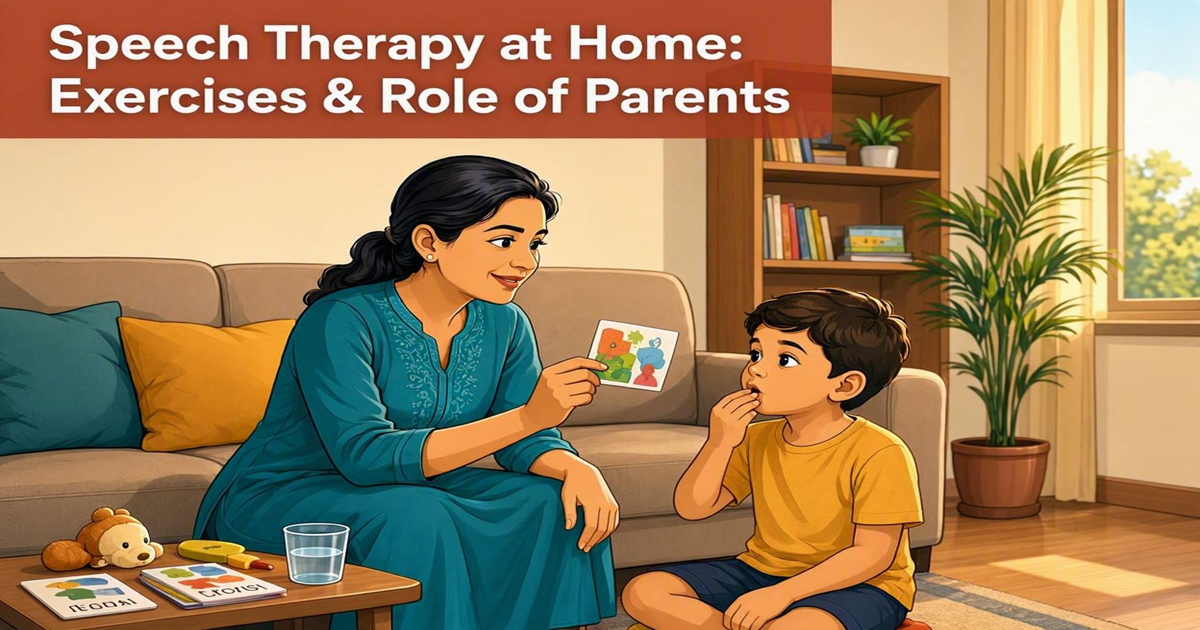
Speech and language development does not happen only during a therapy session. Many communication skills are practiced during everyday activities such as talking, playing, reading, eating, shopping and interacting with family members.
This is why speech therapy at home can be an important part of a structured communication plan. Home practice can give a child or adult additional opportunities to practice skills introduced by a speech-language pathologist (SLP).
What Is Speech Therapy at Home?
Speech therapy at home means practicing speech, language, communication or related skills in the person's everyday environment.
Home practice may be recommended for children with speech delay, articulation difficulties or language difficulties. Adults may also benefit from structured home practice following conditions such as stroke, aphasia or dysarthria, depending on their individual assessment and treatment plan.
Home practice can include therapist-prescribed exercises as well as communication activities naturally incorporated into daily routines.
Why Is Home Practice Important?
A therapy appointment may last only a limited amount of time. Everyday life, however, provides many opportunities to communicate.
Regular home practice can help reinforce skills introduced during therapy and give the person more opportunities to use communication skills in meaningful situations.
- Provides additional opportunities for practice.
- Helps integrate communication into everyday routines.
- Allows parents and caregivers to participate actively.
- Can support consistency between therapy sessions.
- May help families notice changes in communication over time.
- Can make practice more functional and meaningful.
Speech Therapy Exercises You Can Practice at Home
The exercises below are examples of activities that may be useful depending on the individual's needs. They should be adapted rather than followed as a universal treatment program.
1. Sound and Articulation Practice
For people working on specific speech sounds, practice may begin with the target sound and gradually move toward syllables, words and sentences.
For example, a therapist may recommend practicing a particular sound in simple words before introducing more complex words or conversational practice.
2. Picture Naming Exercises
Show a picture and ask the person to identify or describe it. Depending on their ability, the task can range from naming a single object to describing what is happening in a picture.
Examples include:
- "What is this?"
- "What is the person doing?"
- "What color is it?"
- "Where is the ball?"
- "Tell me something about this picture."
3. Word-to-Picture Association
Matching words with pictures can provide a visual way to practice vocabulary and word recognition.
For example, show several pictures and ask the person to select the picture corresponding to a spoken or written word.
4. Following Instructions
Language practice can be incorporated into simple instructions during everyday activities.
Start with instructions appropriate to the person's current level and gradually increase complexity when recommended by the therapist.
Examples include:
- "Pick up the ball."
- "Give me the spoon."
- "Put the book on the table."
- "Take the red cup and put it beside the plate."
5. Sentence Practice
Children or adults working on expressive language may practice building sentences from pictures, objects or everyday situations.
A simple progression might be:
- Single word
- Two-word combination
- Short sentence
- Longer sentence
- Conversation
The appropriate level depends on the person's current communication ability.
6. Reading and Storytelling
Reading a short story together can create opportunities to practice vocabulary, comprehension, sentence formation and conversation.
Parents can ask simple questions such as: "Who is this?", "What happened?", "Where did they go?" or "What do you think will happen next?"
7. Everyday Conversation Practice
Some of the most useful speech practice happens naturally. Talk about breakfast, school, work, shopping, family activities, television programs or plans for the day.
The objective should be meaningful communication rather than simply producing a large number of words.
Speech Therapy Exercises for Children at Home
Children often learn language through interaction. Parents can create communication opportunities throughout the day rather than turning every activity into a formal lesson.
During Play
Follow the child's interests and describe what is happening. For example, during toy play, a parent might model words such as "car", "red car", "car goes", or "the car is fast."
During Mealtimes
Mealtimes can provide opportunities to practice food names, requests, choices, descriptions and simple conversation.
During Bathing and Dressing
Parents can naturally use words related to body parts, clothing, colors, actions and sequences.
During Books and Stories
Ask questions, point to pictures, describe characters and allow the child enough time to respond.
Speech Therapy at Home for Adults
Adults may also require communication practice at home following neurological conditions or other communication difficulties.
Depending on the individual's assessment, home practice may focus on areas such as:
- Word retrieval
- Naming objects and pictures
- Sentence production
- Conversation
- Reading
- Writing
- Speech clarity
- Following spoken instructions
- Functional communication
For people with aphasia or dysarthria, exercises should be individualized. The goals for one person may be very different from those for another.
The Role of Parents in Speech Therapy at Home
Parents are not expected to become speech therapists. Their role is to create supportive communication opportunities and follow the guidance provided by the child's therapist.
A supportive parent can make a significant difference by creating a communication-friendly environment.
1. Create Opportunities to Communicate
Instead of anticipating every need immediately, give the child appropriate opportunities to request, choose, respond or comment.
2. Give Enough Response Time
Some children and adults need additional time to understand a question and formulate a response. Avoid immediately answering for them.
3. Model Language
Parents can demonstrate useful words and sentences without forcing the person to repeat everything.
4. Follow the Therapist's Recommendations
If an SLP recommends specific sounds, words, activities or communication strategies, parents can incorporate them into daily routines.
5. Celebrate Communication Attempts
Communication involves more than perfect pronunciation. Gestures, pointing, facial expressions, writing, pictures, communication devices and spoken words may all be meaningful depending on the person's needs.
How Long Should Speech Exercises Be Practiced at Home?
There is no single practice duration that is appropriate for everyone.
Age, communication difficulty, attention, fatigue, therapy goals and the person's tolerance can all influence the appropriate amount of practice.
Should Home Speech Practice Feel Like Homework?
Not necessarily.
Communication can be practiced naturally throughout the day. Talking while cooking, reading a story, naming objects while shopping or discussing plans for the weekend can all create communication opportunities.
The more meaningful the activity is to the person, the easier it may be for the family to maintain the routine.
Speech Therapy in Hindi: Why Home Practice Can Be More Natural
For many Indian families, communication happens primarily in Hindi or another regional language. Practicing communication in the language used naturally at home can make activities more relevant to everyday life.
Parents can practice familiar words, family names, household objects, common instructions, songs, stories and everyday conversations in the person's preferred language.
Multilingual families do not necessarily need to stop using their home languages because a child or adult has a communication difficulty. The appropriate language strategy should be discussed with a qualified speech-language professional.
Can Melodic Intonation and Rhythm Be Practiced at Home?
Some speech-language therapy approaches use rhythm, melody or intonation as part of structured communication practice. One example is Melodic Intonation Therapy (MIT), which has been used particularly in rehabilitation approaches for some people with non-fluent aphasia.
If a speech-language pathologist incorporates melodic or rhythmic exercises into a person's therapy plan, selected exercises may be practiced at home according to the therapist's instructions.
The exact exercises, complexity and progression should be individualized rather than copied from a generic online routine.
How Digital Tools Can Support Speech Practice at Home
Digital platforms can make structured practice easier to organize, especially when families need additional opportunities between professional therapy sessions.
Depending on the platform, digital speech practice may include:
- Picture identification
- Word-to-picture matching
- Word and sentence practice
- Visual learning activities
- Melodic or rhythmic practice
- Repeated practice opportunities
- Exercise packages assigned by an SLP
- Practice and progress tracking
VaaniSetu is designed to support structured Hindi speech and language practice for patients, caregivers and professionals. Its tools can be used as part of a broader communication practice plan.
How Can Parents Track Speech Therapy Progress?
Progress is not always immediately visible. Parents can work with the therapist to identify meaningful indicators that are relevant to the person's goals.
- New words or communication methods being used.
- Ability to communicate needs and choices.
- Changes in speech clarity.
- Ability to follow instructions.
- Participation in conversations.
- Use of communication strategies outside therapy.
- Response to home practice activities.
- Areas where the person continues to struggle.
A therapist may use more formal assessment measures or structured progress tracking depending on the person's needs.
Common Mistakes Parents Should Avoid
Parents usually want to help as much as possible, but some approaches can unintentionally make communication stressful.
- Correcting every single speech mistake.
- Forcing a child to repeat words repeatedly.
- Comparing the child with siblings or other children.
- Turning every family interaction into a therapy session.
- Practicing when the person is extremely tired or frustrated.
- Using exercises that have not been recommended for the person's needs.
- Expecting immediate results.
- Stopping professional assessment because home practice seems helpful.
When Should You Consult a Speech Therapist?
Home activities can be useful, but professional assessment is important when there are ongoing concerns about speech, language or communication.
Consider consulting a qualified speech-language pathologist if you notice concerns such as:
- A child is not meeting expected communication milestones.
- Speech is difficult for others to understand.
- A child has difficulty understanding or using language.
- A child frequently struggles to communicate needs or ideas.
- An adult develops new communication difficulties.
- Speech or language changes occur after a stroke or neurological event.
- Communication difficulties interfere with school, work or daily life.
Home Speech Therapy vs Professional Speech Therapy
These are not necessarily competing approaches.
Professional therapy can provide assessment, individualized goals, clinical guidance and progress evaluation. Home practice can provide additional opportunities to apply those skills in everyday life.
- Assessment by a qualified speech-language professional.
- Identification of individual communication goals.
- Structured therapy sessions when appropriate.
- A practical home practice plan.
- Regular communication opportunities at home.
- Progress monitoring and adjustment of goals.
A Simple 15-Minute Home Speech Practice Routine
A short routine can be easier for families to maintain. The exact activities should be adapted to the individual's therapy goals.
5 Minutes — Warm-Up
Use simple communication activities such as familiar words, greetings, naming or conversation.
5 Minutes — Structured Practice
Practice the specific sounds, words, pictures, sentences or language activity recommended by the therapist.
5 Minutes — Functional Communication
Finish with a meaningful conversation or everyday activity. Encourage the person to use communication skills in a natural context.
What Makes Home Speech Practice Successful?
Successful home practice is usually less about doing a large number of exercises and more about creating a consistent, supportive communication environment.
- Keep activities appropriate to the person's ability.
- Practice regularly.
- Use meaningful everyday situations.
- Allow enough time to respond.
- Follow professional recommendations.
- Keep activities engaging.
- Monitor fatigue and frustration.
- Review progress regularly with the therapist.
The Goal Is Communication, Not Just Exercise Completion
It is easy to measure how many exercises were completed. But communication progress is broader than completing a list of tasks.
The more meaningful question is: "Is the person becoming better able to communicate what they want, need, understand, feel or think?"
For one person, progress might mean saying a few important words. For another, it might mean participating in a conversation, understanding instructions, improving speech clarity or using an alternative communication method more independently.
Individual goals matter.
Frequently Asked Questions
Can speech therapy be done at home?
Yes. Home practice can support a structured speech-language therapy plan. However, the activities should match the person's communication needs and ideally be guided by a qualified speech-language pathologist.
What are some speech therapy exercises at home?
Depending on the person's goals, activities may include sound practice, picture naming, word-to-picture matching, vocabulary practice, following instructions, sentence practice, reading and everyday conversation.
How can parents help with speech therapy at home?
Parents can create communication opportunities, model useful language, allow enough response time, practice therapist-recommended activities and encourage communication during everyday routines.
How long should speech exercises be practiced at home?
There is no universal duration. Practice should be adjusted according to age, communication needs, attention, fatigue and the therapist's recommendations. Short and consistent practice can be easier to maintain than long sessions.
Can home speech therapy replace a speech therapist?
Home practice generally works best as part of a broader communication plan. A speech-language pathologist can assess the person's needs, establish goals and modify exercises as progress occurs.
Parent Checklist for Home Speech Practice
- ☐ Do we know the person's current communication goals?
- ☐ Are we practicing activities recommended for those goals?
- ☐ Are practice sessions short enough to remain manageable?
- ☐ Are we giving enough time for responses?
- ☐ Are we using everyday situations for communication?
- ☐ Are we avoiding unnecessary pressure and comparison?
- ☐ Are we recording meaningful changes in communication?
- ☐ Are we discussing progress and difficulties with the SLP?
Key Takeaways
- Speech therapy at home can provide valuable opportunities for additional communication practice.
- Home exercises should be individualized rather than treated as a universal program.
- Parents are important communication partners, but they do not need to become speech therapists.
- Everyday activities such as play, meals, reading and conversation can become useful communication opportunities.
- Digital tools can help organize structured practice and track activities when used appropriately.
- Professional assessment and regular review remain important, particularly when communication difficulties are persistent or newly developed.
- The ultimate goal is meaningful, functional communication—not simply completing more exercises.
Make Speech Practice More Structured
VaaniSetu provides Hindi-focused speech and language practice activities that can support structured home practice for patients, caregivers and professionals.
Explore VaaniSetuThis article is provided for general educational and informational purposes only. It is not a substitute for assessment, diagnosis or individualized treatment from a qualified speech-language pathologist, physician or other appropriate healthcare professional.
Speech and language difficulties can have different causes and require different approaches. Do not start, stop or modify a treatment program solely on the basis of information in this article. For sudden speech or language changes, seek urgent medical evaluation.