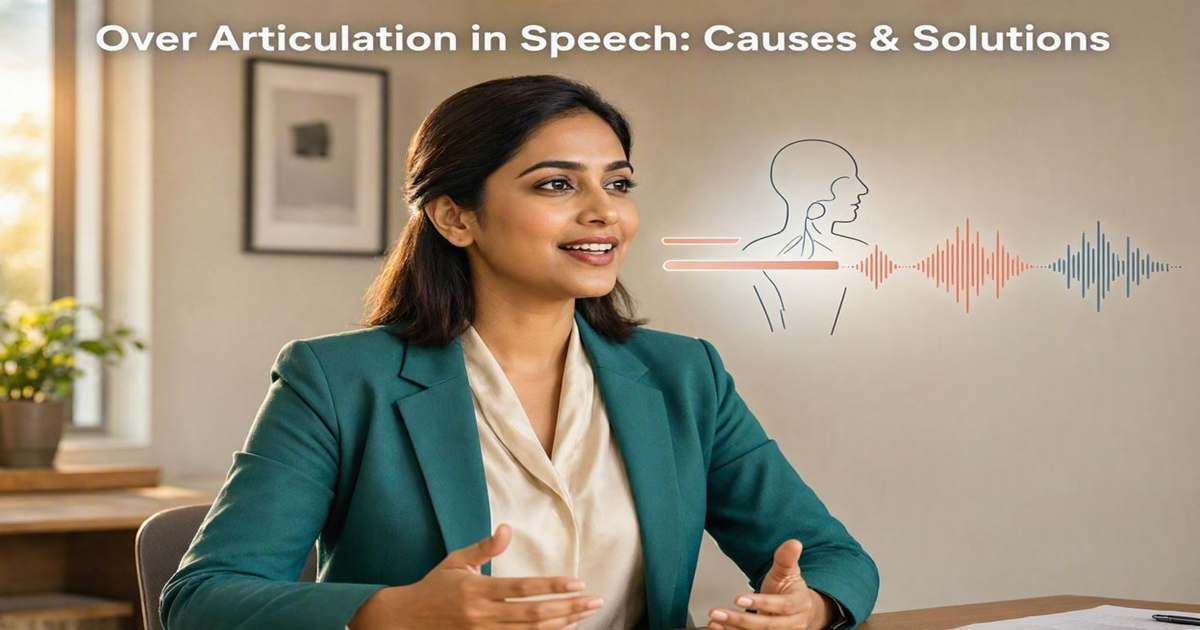
Clear speech depends on the coordinated movement of the lips, tongue, jaw, palate and other structures involved in speech production. Sometimes, a person may produce speech sounds with unusually strong or exaggerated movements. This can affect the natural flow and clarity of communication.
This article explains over articulation in speech, possible causes, common signs and the role of a speech-language pathologist (SLP) in assessment and treatment.
What Is Over Articulation in Speech?
Over articulation generally refers to speech production in which articulatory movements appear excessive, exaggerated or unusually precise compared with the person's typical speaking pattern.
A person may appear to move the mouth, lips or tongue more than necessary while producing particular sounds or words. In some situations, speech may sound effortful, unnatural or overly deliberate.
Common Signs of Over Articulation
Depending on the individual, possible signs may include:
- Exaggerated mouth movements during speech
- Speech that sounds unusually deliberate or effortful
- Excessive emphasis on individual speech sounds
- Difficulty maintaining natural speech rhythm
- Reduced speech efficiency during longer conversations
- Inconsistent speech clarity
- Difficulty transitioning smoothly between sounds
- Visible tension in the lips, jaw or facial muscles
What Can Cause Articulation Problems?
Speech production is a complex motor and language process. Changes in articulation can have many possible causes.
1. Speech Sound Disorders
Children and adults can experience difficulties producing particular speech sounds. These difficulties may affect pronunciation, intelligibility and communication.
2. Neurological Conditions
Conditions affecting the nervous system can sometimes influence speech motor control. Speech-language assessment can help identify the characteristics that need attention.
3. Dysarthria
Dysarthria can affect the strength, coordination, timing and control of speech movements. Depending on the type of dysarthria, speech may become slow, effortful, imprecise or otherwise altered.
4. Apraxia of Speech
Apraxia of speech involves difficulty planning and programming the movements required for speech. A person may know what they want to say but have difficulty coordinating the movements needed to produce the intended sounds.
5. Learned Speech Patterns
Some unusual articulation patterns may develop as learned habits. A speech-language pathologist can determine whether a specific pattern requires intervention.
How Is Over Articulation Assessed?
A speech-language pathologist may assess several aspects of communication rather than looking at pronunciation alone.
- Speech sound production
- Speech intelligibility
- Rate of speech
- Speech rhythm and prosody
- Lip, tongue and jaw movements
- Motor speech coordination
- Ability to produce sounds in words and sentences
- Functional communication during conversation
Speech Therapy for Over Articulation
Speech therapy for articulation problems is individualized. The exact therapy approach depends on the person's age, diagnosis, speech characteristics and communication goals.
A speech-language pathologist may use structured practice to help the individual develop more efficient and natural speech production.
1. Phoneme Practice
Target speech sounds can be practised individually and then gradually incorporated into syllables, words and sentences.
2. Word-Level Articulation Exercises
Repeated practice with carefully selected words can help the learner focus on accurate and controlled speech production.
3. Sentence Practice
After sound and word practice, structured sentence exercises can help transfer the target speech pattern into functional communication.
4. Speech Rate and Pacing
In selected cases, controlled pacing and rhythm-based practice may be incorporated to support more consistent speech timing.
5. Visual and Auditory Feedback
Seeing an image, hearing a target word and repeating it can provide multiple cues during speech practice.
Articulation Exercises for Better Speech Clarity
Structured articulation exercises can be useful when they are selected according to the individual's specific speech needs.
Examples of structured speech practice may include:
- Sound repetition exercises
- Syllable practice
- Word repetition
- Picture-to-word identification
- Word-to-picture matching
- Sentence repetition
- Rhythm-based speech practice
- Controlled speech-rate exercises
Why Consistent Home Practice Matters
Speech therapy is often more effective when structured practice continues between clinical sessions. However, home exercises should be appropriate for the person's therapy goals.
Digital platforms can make it easier for clinicians to provide structured exercises and monitor practice activity between appointments.
How VaaniSetu Can Support Structured Speech Practice
VaaniSetu.in is a digital speech and intonation practice platform designed to support structured speech exercises, including Hindi speech practice.
The platform includes interactive modules for svar practice, visual association, speech exercises, word-picture recognition and progress tracking.
Speech-language pathologists can also create customized exercise packages and assign structured practice according to a patient's individual requirements.
VaaniSetu also provides practice analytics such as attempts, accuracy and practice activity, helping clinicians understand how patients are engaging with assigned exercises.
Hindi Speech Therapy and Articulation Practice
For Hindi-speaking users, practising speech sounds, words and sentences in the language used in everyday communication can be particularly valuable for functional practice.
VaaniSetu includes Hindi-focused speech and intonation activities, allowing users to practise sounds and language through interactive exercises.
Combining visual cues, audio feedback, repetition and structured practice can make home speech exercises more engaging and easier to organize.
When Should You Consult a Speech Therapist?
Consider consulting a qualified speech-language pathologist or speech therapist if speech difficulties are persistent, interfere with daily communication or appear suddenly.
Sudden changes in speech, particularly when accompanied by other neurological symptoms, require prompt medical evaluation.
Frequently Asked Questions
What is over articulation in speech?
Over articulation generally describes speech involving unusually strong, exaggerated or excessive articulatory movements. The underlying reason should be assessed by a speech-language professional.
Can speech therapy help with over articulation?
Speech therapy can address many speech production difficulties. Depending on the individual's needs, therapy may include articulation practice, speech pacing, sound production, sentence practice and other individualized techniques.
What are the best articulation exercises?
There is no single best exercise for everyone. Exercises should be selected according to the person's speech profile, communication goals and professional assessment.
Can Hindi speech exercises improve articulation?
Structured Hindi speech practice can provide repeated practice with relevant sounds, words and sentences. The exercises should be appropriately selected and, when required, supervised by an SLP.
Make Speech Practice More Structured
Explore VaaniSetu for interactive Hindi speech, articulation and intonation practice.
Explore VaaniSetu.inDisclaimer: This article is for educational and informational purposes only. It does not replace an assessment or treatment plan from a qualified speech-language pathologist, speech therapist, neurologist or other healthcare professional.