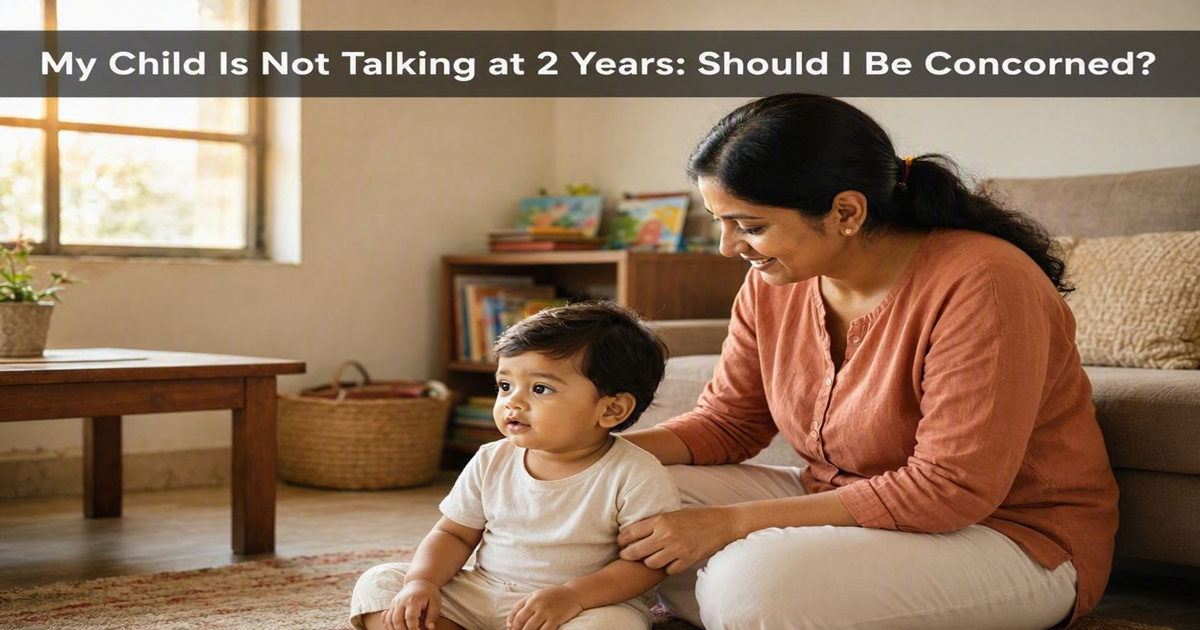
If your child is 2 years old and is not talking—or is using significantly fewer words than expected—it is natural to feel worried.
Parents often hear phrases such as "boys talk late," "give the child some more time," or "he will start talking on his own."
Sometimes a child who talks late does catch up naturally. However, speech and language concerns should not simply be ignored, especially when a child has difficulty understanding language, using gestures, interacting socially, or has lost skills they previously had.
You do not need to panic—but you also do not need to "wait and see" indefinitely. If you are concerned about your child's communication, discussing it with a pediatrician and/or qualified Speech-Language Pathologist can help you understand what is happening and what to do next.
What Should a 2-Year-Old Be Able to Do?
Children's development varies, and milestones should not be treated as a rigid pass-or-fail test.
At around age 2, many children are developing rapidly in their ability to understand language, use words, combine words, communicate needs and participate in simple interactions.
Many children can understand familiar words, simple instructions and everyday questions.
Children are typically developing a growing vocabulary and beginning to combine words.
Pointing, showing, waving, nodding and other gestures can support communication.
Children increasingly use communication to request, share attention, respond and interact.
A child's communication development includes much more than the number of words they can say. Understanding, gestures, interaction, play, social communication and ability to communicate needs are also important.
What Does "Not Talking at 2" Actually Mean?
Parents may use "not talking" to describe very different situations.
No Spoken Words
The child rarely or never uses recognizable spoken words.
Very Few Words
The child uses some words but has a very limited vocabulary compared with what parents expect.
Words but No Combinations
The child uses individual words but is not yet combining words meaningfully.
Speech Is Difficult to Understand
The child attempts to communicate but parents have difficulty understanding the speech.
These situations can have different causes and may require different types of assessment.
Signs That Your 2-Year-Old May Need a Speech and Language Evaluation
Consider talking with a healthcare professional or Speech-Language Pathologist if your child has one or more concerning communication signs.
Very Limited Vocabulary
The child uses very few meaningful words or rarely attempts to communicate verbally.
Difficulty Understanding
The child frequently appears unable to understand simple familiar instructions or questions.
Limited Gestures
The child rarely points, waves, shows objects or uses gestures to communicate.
Limited Social Communication
The child has persistent difficulty engaging in back-and-forth communication or sharing attention.
Regression
The child stops using words, gestures or other communication skills they previously had.
Parents Remain Concerned
Even when you cannot identify a specific problem, persistent parental concern is a reasonable reason to discuss development with a professional.
If a child loses previously acquired speech, language, social or other developmental skills, seek professional evaluation promptly.
Why Is My 2-Year-Old Not Talking?
There is no single explanation for delayed talking. Communication development can be influenced by many factors.
Late Language Emergence
Some children develop spoken language later than their peers while otherwise showing relatively typical development.
Hearing Difficulties
Hearing problems can affect a child's ability to learn and use spoken language. Hearing assessment may therefore be an important part of evaluation.
Speech Sound Difficulties
Some children understand language but have difficulty producing speech sounds clearly.
Language Development Difficulties
A child may have difficulty understanding or using language, including learning and combining words.
Broader Developmental Differences
Speech delay can sometimes occur alongside other developmental differences. A complete developmental evaluation can help identify whether additional assessment is appropriate.
Multiple Factors
More than one factor may contribute to a child's communication difficulties.
Could Hearing Loss Be the Reason My Child Is Not Talking?
Hearing plays an important role in speech and language development.
A child does not need to have obvious deafness for hearing difficulties to affect communication. Temporary or fluctuating hearing problems can also interfere with access to speech sounds.
If a child has a significant speech or language delay, discussing a hearing evaluation with the child's healthcare provider can be an important step.
What If My Child Is Growing Up With Hindi and English?
Many children in India grow up hearing two or more languages. Parents sometimes worry that using Hindi and English together is causing their child to talk late.
Exposure to multiple languages does not automatically mean that a child has a speech or language disorder.
When assessing a multilingual child, communication should be considered across the languages the child regularly hears and uses rather than judging development from only one language.
Parents can continue communicating naturally in the languages they are comfortable using. Rich, responsive interaction is more important than forcing a particular language simply because of concerns about speech delay.
When Should a 2-Year-Old See a Speech Therapist?
There is no benefit in waiting for a child to reach a particular birthday if parents have genuine concerns.
A qualified Speech-Language Pathologist (SLP) can assess speech, language, communication and related skills and determine whether the child needs monitoring, further assessment or intervention.
Early assessment can also give parents practical strategies for supporting communication during everyday activities.
Sometimes a professional may recommend monitoring and communication-rich home activities. In other situations, structured speech and language intervention may be appropriate.
What Happens During a Child Speech and Language Evaluation?
Parents may wonder what will happen when they take their child to a speech therapist.
Depending on the child's age and needs, an assessment may look at several areas.
- Understanding of spoken language
- Words the child currently uses
- Ability to combine words
- Speech sound development
- Gestures and non-verbal communication
- Social communication and interaction
- Play and communication during activities
- Communication across languages, when relevant
The professional may also ask parents about pregnancy and birth history, developmental milestones, hearing, medical history and the child's communication at home.
Simple Speech Activities for a 2-Year-Old at Home
Parents do not need expensive equipment to create opportunities for communication.
Everyday routines can become useful language-learning opportunities.
Name Everyday Objects
During meals, bathing or play, repeatedly name familiar objects such as cup, ball, spoon, पानी, दूध or खिलौना.
Use Picture Books
Point to pictures, name them and encourage your child to look, point, imitate or attempt the word.
Expand Attempts
If your child says "ball", you can respond with "red ball" or "ball do" rather than demanding repetition.
Offer Choices
Instead of immediately giving an object, offer simple choices such as "apple or banana?"
Use Songs and Rhymes
Simple songs, nursery rhymes and rhythmic activities can create enjoyable opportunities for imitation, sounds and words.
Follow Your Child's Interest
Join your child during play and talk about what they are already looking at, touching or doing.
Hindi Speech Activities for Toddlers
For families who primarily communicate in Hindi, speech and language activities can naturally be incorporated into Hindi everyday conversations.
For example, parents can practice simple words related to familiar objects and routines:
पानी → दूध → गेंद → मम्मी → पापा → खाना → आओ → जाओ
As the child becomes comfortable with individual words, parents can naturally expand them into short combinations such as: "पानी दो" or "गेंद दो".
The objective should be meaningful communication—not forcing a child to repeat a word again and again without understanding its purpose.
Why Pictures Can Help Children Learn Words
Young children often learn language through repeated experiences with people, objects, actions and pictures.
Visual activities can therefore be useful when practicing vocabulary.
See
Show a picture or real object.
Hear
Clearly name the object.
Communicate
Encourage pointing, choosing, imitating or saying the word.
What About Screen Time and Speech Delay?
Parents frequently ask whether mobile phones, television and other screens are responsible for a child's speech delay.
The relationship between screen exposure, family interaction and child development is complex. It is more useful to focus on the quality of a child's overall environment rather than assuming that every speech delay has one simple cause.
Make time for face-to-face interaction, shared reading, play, talking, singing and responsive communication every day. Follow age-appropriate pediatric guidance regarding screen use.
How VaaniSetu Can Support Speech Practice
VaaniSetu is designed to provide structured digital speech and language practice with a focus on accessible activities and visual learning.
Depending on the child's individual needs and the plan provided by an SLP, digital practice can complement everyday communication activities.
- Picture Identification
- Word-to-Photo Matching
- Word Practice
- Sentence Practice
- Visual and Cognitive Activities
- Structured Practice Tracking
Parents and caregivers can use structured activities as part of a broader communication program rather than relying on an app as the sole method of speech development.
What Parents Should Avoid When a Child Is Not Talking
Don't Compare Constantly
Comparing your child with siblings, cousins or neighborhood children can create unnecessary anxiety.
Don't Force Repetition
Repeatedly demanding "say it" can turn communication into a stressful activity.
Don't Ignore Regression
Losing previously acquired communication skills deserves prompt professional attention.
Don't Wait Indefinitely
If concerns persist, seeking an evaluation can provide useful information instead of relying on guesses about when the child will start talking.
Why Early Speech and Language Support Matters
Early childhood is an important period for communication, learning and social development.
Early identification does not mean that every child needs intensive therapy. It means that concerns can be evaluated earlier and families can receive appropriate guidance.
A professional assessment can help determine whether the child is developing within an expected range, needs monitoring, or could benefit from targeted speech and language support.
2-Year-Old Speech Delay: Parent Checklist
Ask yourself the following questions:
- Does my child use meaningful words?
- Does my child understand familiar instructions?
- Does my child point or use gestures?
- Does my child try to communicate wants and needs?
- Does my child interact with parents and caregivers?
- Does my child imitate sounds, actions or words?
- Has my child stopped using any previously learned words?
- Have I had concerns about my child's hearing?
- Are my concerns continuing even though others tell me to wait?
If several answers concern you, consider discussing your child's development with a pediatrician and a qualified Speech-Language Pathologist.
Support Your Child's Speech Journey
Explore structured speech and language practice activities with VaaniSetu and support your child's communication development alongside guidance from qualified professionals.
Visit VaaniSetu.inKey Takeaways for Parents
- Children develop speech and language at different rates, but persistent concerns at age 2 are worth discussing with a professional.
- "Not talking" can mean no words, very few words, difficulty combining words or difficulty making speech understandable.
- Communication includes understanding, gestures, social interaction and language—not just spoken words.
- Hearing should be considered when evaluating significant speech and language concerns.
- Growing up with Hindi, English or multiple languages does not automatically cause a speech disorder.
- Parents can support communication through talking, reading, play, songs, gestures and everyday routines.
- Early evaluation does not necessarily mean a child will need long-term therapy.
- If a child loses previously acquired communication skills, professional evaluation should be sought promptly.
Frequently Asked Questions
1. Is it normal for a 2-year-old not to talk?
Children develop at different rates, and some late talkers catch up. However, very limited spoken language at age 2, especially when combined with concerns about understanding, gestures, social communication or regression, is a reasonable reason to seek professional advice.
2. My 2-year-old understands everything but does not speak. Should I be worried?
Good understanding is an encouraging part of communication, but a significant gap in spoken language can still deserve assessment. A Speech-Language Pathologist can evaluate the child's overall communication profile and provide guidance.
3. Should I wait until my child is 3 before speech therapy?
There is generally no need to wait for a specific birthday before discussing a communication concern. Early assessment can help determine whether monitoring, home strategies or professional intervention is appropriate.
4. Can speech delay be treated at home?
Parents can create many valuable language-learning opportunities through play, reading, conversation, songs and everyday routines. When a delay is suspected, however, home activities should complement professional assessment rather than replace it.
5. Does speaking Hindi and English cause speech delay?
Exposure to more than one language does not automatically cause a speech or language disorder. Multilingual children should be assessed across the languages they regularly hear and use.
6. Can hearing problems cause speech delay?
Hearing is important for speech and language learning. Hearing difficulties can affect access to speech sounds, so hearing assessment may be considered when evaluating communication concerns.
7. When should I see a speech therapist for my toddler?
Consider seeking professional guidance when your child has very limited words, difficulty understanding language, limited gestures or social communication, unclear speech, loss of previously acquired communication skills, or when your concerns persist.
If your child loses previously acquired speech, language, social or other developmental skills, seek professional evaluation promptly rather than waiting for the skills to return on their own.
This article is provided for general educational and informational purposes only. It does not provide a diagnosis or medical advice. Speech and language development varies between children. If you are concerned about your child's communication, consult a pediatrician, qualified Speech-Language Pathologist or other appropriate healthcare professional for an individualized assessment.