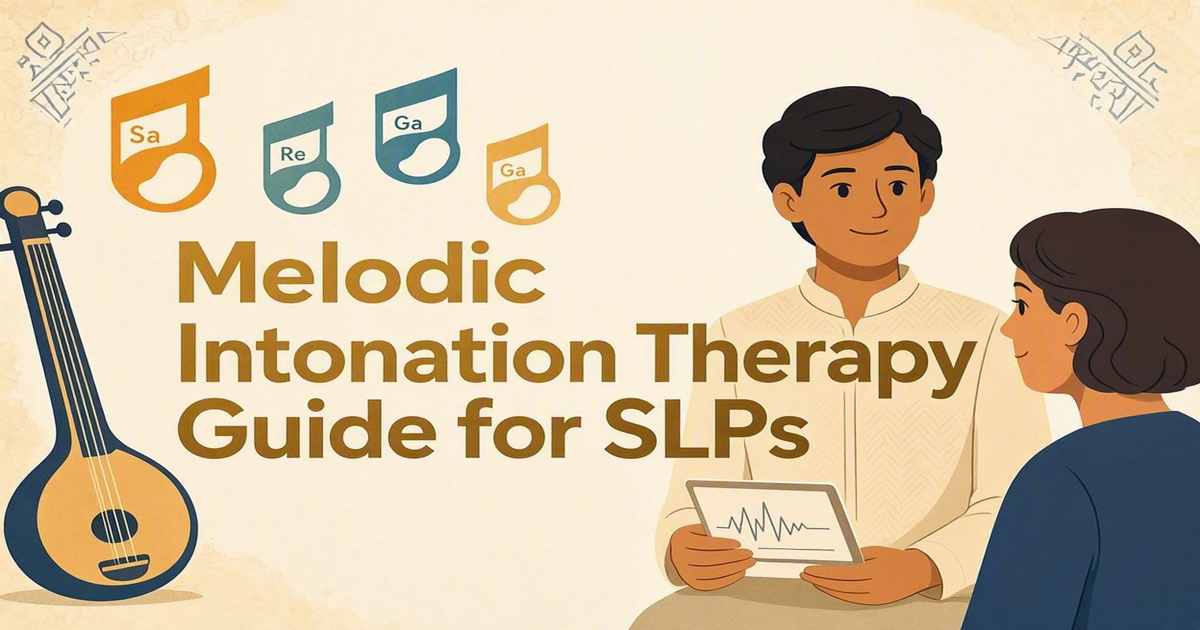
Melodic Intonation Therapy (MIT) is a structured speech rehabilitation approach that uses elements of melody, rhythm, stress and intonation to support speech production in selected individuals.
For Speech-Language Pathologists (SLPs), MIT can be considered as one component of an individualized intervention plan, particularly when working with appropriate clients with non-fluent aphasia.
When working with Hindi-speaking clients, clinicians can also adapt speech materials to include familiar Hindi words, phrases and functional communication targets.
What Is Melodic Intonation Therapy?
Melodic Intonation Therapy uses the melodic and rhythmic aspects of speech to facilitate production of meaningful utterances.
The approach is particularly associated with people with non-fluent aphasia, especially individuals who experience difficulty producing propositional speech despite retaining some ability to produce automatic or highly familiar verbal material.
Patient suitability should always be determined through a comprehensive clinical assessment.
Why Does Melody Matter in Speech Rehabilitation?
Speech naturally contains changes in pitch, stress, timing and rhythm.
MIT deliberately emphasizes these characteristics during structured practice.
For selected individuals, rhythmic and melodic cues may provide an additional route for supporting speech production and initiation.
The clinician's role is to determine how these cues should be introduced, reduced or modified according to the client's response.
Which Patients May Be Appropriate for MIT?
MIT is most commonly discussed in relation to selected individuals with non-fluent aphasia. However, diagnosis alone does not determine suitability.
The SLP should consider the individual's overall communication profile.
- Type and severity of aphasia
- Verbal expression abilities
- Auditory comprehension
- Ability to imitate or repeat
- Motor speech characteristics
- Ability to participate in structured practice
- Cognitive and attention abilities
- Functional communication needs
Core Components of Melodic Intonation Therapy
1. Melodic Intonation
The clinician introduces a melodic pattern to the target utterance. Pitch variation can be used to distinguish and emphasize syllables or words.
2. Rhythmic Structure
Rhythm provides temporal organization during speech production and may be combined with controlled repetition.
3. Tapping or Rhythmic Cueing
Rhythmic tapping may be used as an external cue during selected tasks. The clinician can determine when the cue is appropriate and how it should be faded.
4. Repetition
Repeated production of carefully selected targets provides opportunities for structured speech practice.
5. Functional Language
Targets should ideally have communicative relevance to the individual rather than consisting only of meaningless sequences.
A Practical MIT Session Structure for SLPs
A therapy session can be structured around a progression from stronger external cues toward increasingly independent speech production.
Select the Target
Choose a meaningful word, phrase or sentence that matches the client's communication goals.
Establish the Rhythm
Introduce an appropriate rhythmic pattern and provide the level of cueing required.
Add Melody and Intonation
Use an appropriate melodic contour while maintaining the target utterance.
Produce Together
The clinician and client may produce the target together depending on the therapy approach and cueing requirements.
Reduce Cues
Gradually reduce external support when the client demonstrates greater independence.
Move Toward Functional Speech
Progress toward more natural spoken production and meaningful communication.
Choosing the Right Speech Targets
Target selection is one of the most important clinical decisions when designing structured speech practice.
| Target | Example | Clinical Consideration |
|---|---|---|
| Functional Word | पानी | Select familiar and meaningful vocabulary. |
| Short Phrase | पानी चाहिए | Useful for functional communication. |
| Sentence | मुझे पानी चाहिए। | Introduce when appropriate for the client's current abilities. |
| Personal Phrase | मेरा नाम... | Personally meaningful targets can increase functional relevance. |
Adapting Melodic Intonation Therapy for Hindi
Language-specific adaptation is important when designing speech rehabilitation activities.
For Hindi-speaking clients, clinicians may select familiar vocabulary, culturally relevant phrases and naturally occurring Hindi communication patterns.
VaaniSetu's approach to structured Hindi speech practice can organize exercises around Swar, Shabd, phrases and sentences.
स्वर अभ्यास — Swar Abhyas
Structured vocal and vowel practice can provide foundational speech practice where clinically appropriate.
शब्द अभ्यास — Shabd Abhyas
Familiar Hindi words can then be incorporated into repeated and structured speech activities.
वाक्य अभ्यास — Sentence Practice
मुझे घर जाना है।
Functional phrases and sentences can be introduced as the client's abilities allow.
Swar → Shabd → Phrase → Sentence
For digital Hindi speech practice, clinicians can organize activities into progressive levels.
Swar → Shabd → Phrase → Sentence
The objective is to progressively move from simpler speech practice toward functional communication, according to the client's individual abilities.
Using Digital Tools for MIT Home Practice
Therapy does not necessarily end when the clinical session ends. Carefully designed home practice can provide additional opportunities for repetition and skill reinforcement.
Digital platforms can help clinicians organize these activities and provide patients or caregivers with clearly defined practice tasks.
The important principle is that technology should support the clinical plan rather than replace professional assessment.
How VaaniSetu Can Support SLPs
VaaniSetu.in is designed as a digital platform for structured speech and language practice.
Speech-Language Pathologists can use digital exercises to organize patient practice and support structured activities between therapy sessions.
🎵 Intonation & Melodic Practice
Structured activities can incorporate speech rhythm, intonation and repeated vocal practice.
🔤 Swar Practice
Hindi vocal and vowel-focused exercises can be organized into structured practice activities.
🗣️ Shabd Practice
Meaningful Hindi words can be practised repeatedly as part of a customized exercise package.
🖼️ Visual Speech Practice
Picture identification, picture-word association and word-to-picture activities can provide additional language and speech cues.
📊 Patient Progress Tracking
Digital tracking can help clinicians review assigned exercises and patient practice activity.
How SLPs Can Design Better Home Practice
Effective home practice should be structured, understandable and aligned with the individual's clinical goals.
- Keep targets meaningful and functional.
- Start with an appropriate level of difficulty.
- Use consistent instructions.
- Provide appropriate auditory or visual cues.
- Use repetition without making practice unnecessarily overwhelming.
- Progress from simpler targets to more complex communication.
- Monitor performance and modify exercises when needed.
Common Mistakes to Avoid When Using MIT
❌ Treating MIT as Simple Singing
MIT is a structured speech rehabilitation approach, not simply singing words or songs.
❌ Using the Same Targets for Every Patient
Communication needs and speech profiles vary. Targets should be individualized.
❌ Keeping Cues Too Long
Where appropriate, clinicians should consider reducing external cues as independent production develops.
❌ Ignoring Functional Communication
Practice should ultimately connect with meaningful communication whenever possible.
Measuring Progress During Speech Therapy
Progress should be monitored using measures that are relevant to the individual's treatment goals.
Depending on the therapy plan, an SLP may monitor:
- Accuracy of target production
- Level of cueing required
- Number of successful repetitions
- Ability to produce targets independently
- Speech intelligibility
- Functional communication
- Generalization to spontaneous communication
MIT and Functional Communication
The ultimate goal of speech rehabilitation is not simply successful repetition inside a therapy session.
Clinicians should consider whether improvements in structured practice transfer to meaningful communication in everyday situations.
Functional targets such as requesting food, asking for water, introducing oneself or communicating with family members can make speech practice more personally relevant.
A Practical Digital Workflow for SLPs
Assess
Evaluate the client's speech, language and communication profile.
Plan
Select appropriate functional speech targets.
Create Exercises
Organize Swar, Shabd, phrase, sentence or intonation activities according to the therapy plan.
Assign Practice
Provide structured exercises for appropriate home practice.
Monitor
Review practice activity and observed performance.
Adjust
Modify targets and cueing based on clinical progress.
Frequently Asked Questions for SLPs
What is Melodic Intonation Therapy?
Melodic Intonation Therapy is a structured speech rehabilitation approach using melody, rhythm, stress and intonation to support speech production in selected individuals.
Is MIT suitable for all aphasia patients?
No. MIT is not appropriate for every person with aphasia. Patient selection should be based on comprehensive clinical assessment and individual treatment goals.
What is the role of an SLP in MIT?
The SLP evaluates the client's communication profile, selects appropriate targets, determines cueing strategies, monitors performance and modifies the intervention as needed.
Can MIT be adapted for Hindi-speaking clients?
Yes. Hindi words, phrases and functional sentences can be incorporated into an individualized speech rehabilitation program.
How can Swar and Shabd practice complement Hindi speech rehabilitation?
Structured Swar and Shabd activities can provide progressive practice opportunities, moving from simpler vocal patterns toward meaningful words and functional sentences when appropriate.
Can VaaniSetu support SLP home practice?
VaaniSetu provides digital speech and language practice activities including Swar, Shabd, sentence, visual and intonation-based exercises. These activities can complement an individualized therapy plan.
Bring Structured Speech Practice Online
Create, assign and monitor structured speech exercises with VaaniSetu.
Explore VaaniSetu for SLPsClinical Disclaimer: This article is intended for educational and professional information purposes. It does not constitute a clinical treatment protocol or replace professional assessment. Melodic Intonation Therapy should be considered and implemented according to the individual client's communication profile, clinical needs and the professional judgment of a qualified Speech-Language Pathologist.