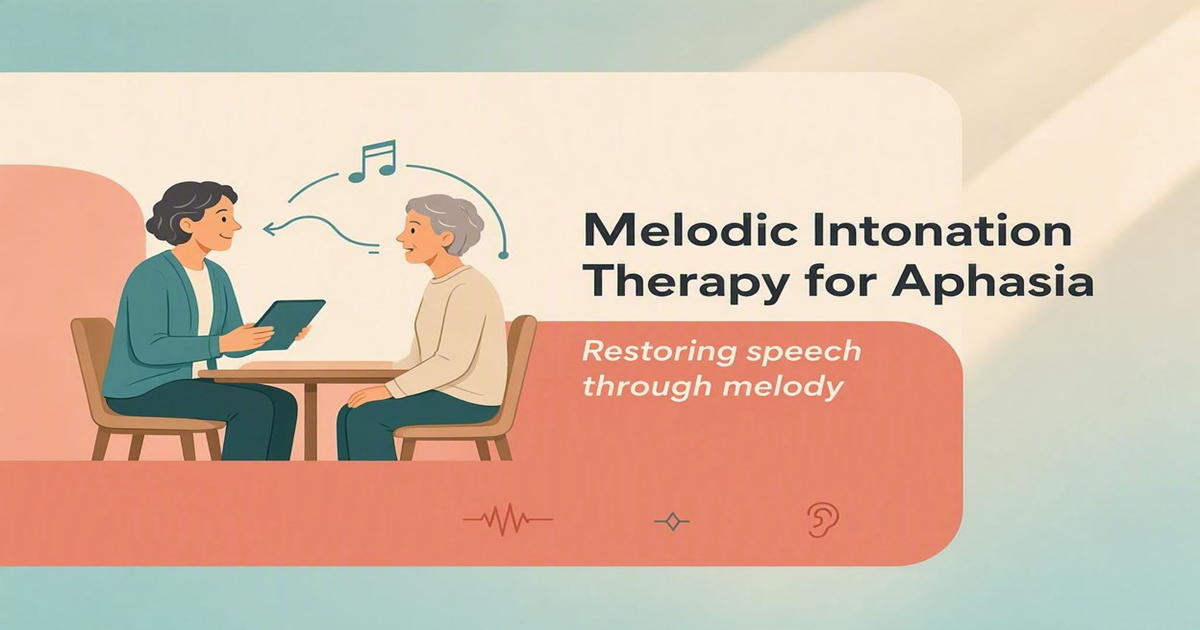
Losing the ability to speak fluently after a stroke can be frustrating and emotionally difficult. A person may know exactly what they want to say but struggle to produce the words.
One rehabilitation approach that has received attention for selected people with aphasia is Melodic Intonation Therapy (MIT).
MIT uses elements such as melody, rhythm, repetition, structured phrases and gradual speech practice to help a person work on verbal expression.
Instead of practicing speech only as ordinary spoken words, MIT can pair words and phrases with a simple melodic and rhythmic pattern, gradually encouraging the person to move toward more natural speech.
What Is Aphasia?
Aphasia is a language disorder caused by damage to areas of the brain responsible for language. Stroke is one of the most common causes.
Aphasia can affect different aspects of communication, including:
- Speaking
- Understanding language
- Reading
- Writing
- Finding the right words
- Forming meaningful sentences
Not everyone experiences aphasia in the same way. Some people understand language relatively well but struggle to produce fluent speech, while others may have difficulties with both understanding and expression.
What Is Melodic Intonation Therapy?
Melodic Intonation Therapy is a structured speech-language rehabilitation technique that uses musical elements such as melody and rhythm alongside verbal practice.
It is particularly associated with rehabilitation for people who have difficulty producing spoken language, including some people with non-fluent aphasia.
The goal is not simply to "sing instead of speaking." Rather, structured melodic and rhythmic cues can be used as part of a progression toward intentional spoken communication.
MIT is a specialized rehabilitation approach. A qualified Speech-Language Pathologist should determine whether it is appropriate for a particular person and how it should be adapted.
Why Can Music and Rhythm Be Useful for Speech Practice?
One of the interesting aspects of MIT is that speech is practiced together with structured musical and rhythmic cues.
Melody and rhythm can provide a predictable framework for repeatedly producing sounds, words and phrases.
Rhythmic Structure
A consistent beat can provide a timing framework for producing a phrase repeatedly.
Melodic Cueing
A simple melody can be paired with words or phrases during structured practice.
Repetition
Repeated practice provides opportunities to strengthen consistent production of targeted words and phrases.
Gradual Progression
Practice can progress from simpler vocalizations and words toward longer, more functional phrases.
How Does Melodic Intonation Therapy Work?
A typical MIT-based program is structured rather than simply asking someone to sing.
Depending on the individual's abilities, therapy may progress through several levels.
- Listening to and recognizing a target phrase.
- Producing the phrase with strong melodic and rhythmic cues.
- Repeating the phrase with decreasing assistance.
- Practicing the phrase with more natural speech patterns.
- Applying the learned communication in functional situations.
The purpose is not to make a person permanently dependent on singing. Structured cues are gradually adjusted as speech production becomes more independent.
Melodic Intonation Therapy in Hindi
Language matters when designing speech rehabilitation.
Hindi has its own pronunciation patterns, syllable structures, vocabulary, rhythm and natural speech patterns. Therefore, providing speech practice in Hindi should involve more than simply translating an English therapy exercise word-for-word.
Hindi-specific melodic and rhythmic speech practice can use familiar words, phrases and language patterns that are meaningful to the person.
Familiar language can make practice more relevant to a person's everyday communication with family, caregivers and the community.
What Does Research Say About Hindi Melodic Intonation Therapy?
Hindi-specific MIT has recently received research attention in India.
In July 2026, researchers from IIT Delhi, AIIMS New Delhi and IHBAS reported the development and pilot evaluation of a Hindi adaptation of Melodic Intonation Therapy for people with post-stroke aphasia.
The researchers reported that the adaptation considered the rhythm and linguistic characteristics of Hindi rather than treating it as a simple word-for-word translation.
Six Hindi-speaking stroke survivors participated in the pilot, with each receiving 40 therapy sessions lasting approximately 45–60 minutes. The researchers reported improvements in areas such as sentence production, speech fluency and quality of life.
The results are promising, but this was a small pilot study. Six participants are not enough to establish that Hindi MIT will work equally well for everyone. Larger studies are needed to determine its effectiveness more confidently.
Who May Benefit From Melodic Intonation Therapy?
MIT is not automatically appropriate for every person with aphasia.
It may be considered for selected individuals, particularly when spoken expression is significantly affected and other abilities make structured practice feasible.
A Speech-Language Pathologist can assess factors such as:
- Type and severity of aphasia
- Ability to understand spoken language
- Ability to produce sounds and words
- Attention and cognitive abilities
- Motor speech difficulties
- Communication goals
- Ability to participate in repeated practice
Is MIT the Same as Singing?
No.
Although singing and melody are important components, MIT is a structured speech rehabilitation approach.
The objective is to use melodic and rhythmic support as a bridge toward functional verbal communication.
Simply singing songs at home is therefore not equivalent to receiving Melodic Intonation Therapy.
Examples of Music and Rhythm-Based Speech Practice
A structured program may include different levels of speech practice depending on the individual's abilities.
Vowel and Swar Practice
Practice simple vowel sounds using controlled pitch, timing and repetition.
Example: आ — आ — आ
Single Word Practice
Practice meaningful words repeatedly using a consistent rhythmic or melodic cue.
Example: पानी
Short Phrases
Move from individual words to short functional expressions.
Example: पानी दो
Sentence Practice
Gradually practice longer phrases while reducing external cues.
Example: मुझे पानी चाहिए।
From Swar to Shabd to Vakya
One useful way to think about structured Hindi speech practice is to move progressively from smaller speech units to meaningful communication.
Swar → Shabd → Vakya → Conversation
Sound practice can provide a foundation for word practice, words can be combined into meaningful sentences, and sentences can eventually be used in everyday conversations.
The exact sequence and difficulty should always be adapted to the individual's communication abilities.
Other Hindi Speech Exercises That Can Complement Practice
Melodic practice can be one part of a broader speech and language rehabilitation program.
Photo Identification
Identify familiar objects, people, places or actions using visual cues.
Word-to-Photo Matching
Connect written or spoken words with corresponding pictures to support language associations.
Shabd Abhyas
Practice meaningful Hindi words through structured repetition and recall.
Sentence Practice
Build short and functional Hindi sentences based on everyday communication needs.
Can Melodic Speech Practice Be Done at Home?
Home practice can be an important part of rehabilitation when it is based on a suitable plan provided by a qualified professional.
Families and caregivers can support practice by creating a calm, consistent environment.
- Practice for short, manageable periods.
- Use familiar and meaningful words.
- Repeat targeted phrases consistently.
- Reduce distractions during practice.
- Give the person enough time to respond.
- Celebrate communication attempts rather than focusing only on errors.
- Follow the exercise plan recommended by the SLP.
Fatigue, frustration and cognitive overload can make practice less productive. Quality and consistency are generally more important than simply increasing the number of repetitions.
How VaaniSetu Can Support Hindi Speech Practice
VaaniSetu is designed to provide structured digital speech practice with a focus on Hindi language exercises.
The platform brings together different types of practice that can be useful as part of an individualized rehabilitation program.
- Melodic Intonation Practice
- Swar Abhyas
- Shabd Abhyas
- Sentence Practice
- Photo Identification
- Word-to-Photo Association
- Practice and Attempt Tracking
For SLPs, structured digital exercises can also make it easier to organize patient practice and monitor participation over time.
The Role of Family in Aphasia Recovery
Speech rehabilitation does not happen only during therapy sessions. Family members can play an important role in creating opportunities for communication throughout the day.
Instead of immediately completing every sentence for the person, caregivers can provide appropriate time and cues.
Helpful communication habits include:
- Speak slowly and naturally.
- Use short and clear sentences when needed.
- Give extra response time.
- Use pictures or gestures when useful.
- Ask one question at a time.
- Encourage communication attempts.
- Avoid treating communication mistakes as a lack of intelligence.
What About Dysarthria or Apraxia?
Aphasia is a language disorder, while dysarthria is primarily a motor speech disorder affecting the strength, coordination or control of speech muscles.
Apraxia of speech involves difficulty planning and coordinating the movements needed for speech.
A person can also have more than one communication disorder after a stroke.
The most appropriate speech exercises depend on the underlying communication difficulty. A Speech-Language Pathologist should assess the individual before selecting a rehabilitation approach.
Can Melodic Intonation Therapy Restore Speech Completely?
There is no single therapy that can guarantee complete recovery from aphasia.
Aphasia recovery depends on many factors, including the location and extent of brain injury, severity of communication impairment, overall health, therapy participation and individual recovery patterns.
Some people experience significant improvement, while others may continue to have communication difficulties and benefit from long-term strategies and communication support.
Progress may mean producing a word more consistently, forming a short phrase, communicating a need, participating in a conversation or becoming more confident in everyday communication.
When Should You Consult a Speech-Language Pathologist?
Professional assessment is especially important when a person develops new communication difficulties after a stroke or brain injury.
An SLP can evaluate communication abilities and develop an individualized rehabilitation program.
If the person is having difficulty speaking, understanding, reading, writing, finding words or communicating basic needs, professional evaluation should not be delayed.
Explore Hindi Speech Practice with VaaniSetu
Practice Swar, Shabd, sentences, visual language activities and melodic speech exercises through a structured digital platform designed around Hindi communication.
Visit VaaniSetu.inKey Takeaways
- Melodic Intonation Therapy uses melody and rhythm as part of structured speech rehabilitation.
- MIT may be useful for selected people with aphasia, particularly some individuals with non-fluent speech.
- MIT is not simply singing; it is a structured therapeutic approach.
- Hindi-specific speech rehabilitation can make practice more relevant for Hindi-speaking individuals.
- Hindi MIT research is emerging, with early Indian pilot findings showing promising signals but requiring confirmation through larger studies.
- Swar, Shabd, sentence and functional communication practice can form part of a broader rehabilitation program.
- Home practice should follow an individualized plan and should not replace professional assessment when needed.
Frequently Asked Questions
1. What is Melodic Intonation Therapy for aphasia?
Melodic Intonation Therapy is a structured speech-language rehabilitation approach that incorporates melody, rhythm and repeated verbal practice to support speech production in selected people with aphasia.
2. Can music help someone with aphasia speak?
Structured musical and rhythmic cues may support speech production in some people with aphasia. However, individual responses vary and music alone should not be considered a replacement for professional speech-language rehabilitation.
3. Is MIT useful after stroke?
MIT has been studied as a rehabilitation approach for post-stroke aphasia, particularly for difficulties with non-fluent verbal expression. Its suitability depends on the individual's communication profile.
4. Can MIT be used for Hindi-speaking stroke patients?
Hindi adaptations of MIT have been developed and investigated. Hindi speech practice can incorporate culturally and linguistically familiar words, phrases, rhythm and speech patterns.
5. Is Melodic Intonation Therapy a cure for aphasia?
No. MIT is not a guaranteed cure. It is a rehabilitation approach that may support communication and speech production for appropriate individuals.
6. Can I practice MIT at home?
Home practice may be appropriate when it follows a structured plan recommended by a qualified Speech-Language Pathologist. Unsupervised exercises should not replace individualized assessment.
If a person suddenly develops difficulty speaking, facial drooping, weakness or numbness of an arm or leg, confusion, vision problems or severe loss of coordination, treat it as a possible stroke emergency and seek immediate medical attention.
This article discusses Melodic Intonation Therapy based on published research and recent Indian research on Hindi adaptation. The July 2026 Hindi MIT pilot was conducted by researchers associated with IIT Delhi, AIIMS New Delhi and IHBAS and was published in the journal Aphasiology.
This article is intended for educational and informational purposes only. It does not provide medical advice, diagnosis or treatment. Aphasia and other communication disorders can vary significantly between individuals. Always consult a qualified Speech-Language Pathologist and appropriate medical professionals for assessment and individualized rehabilitation planning.