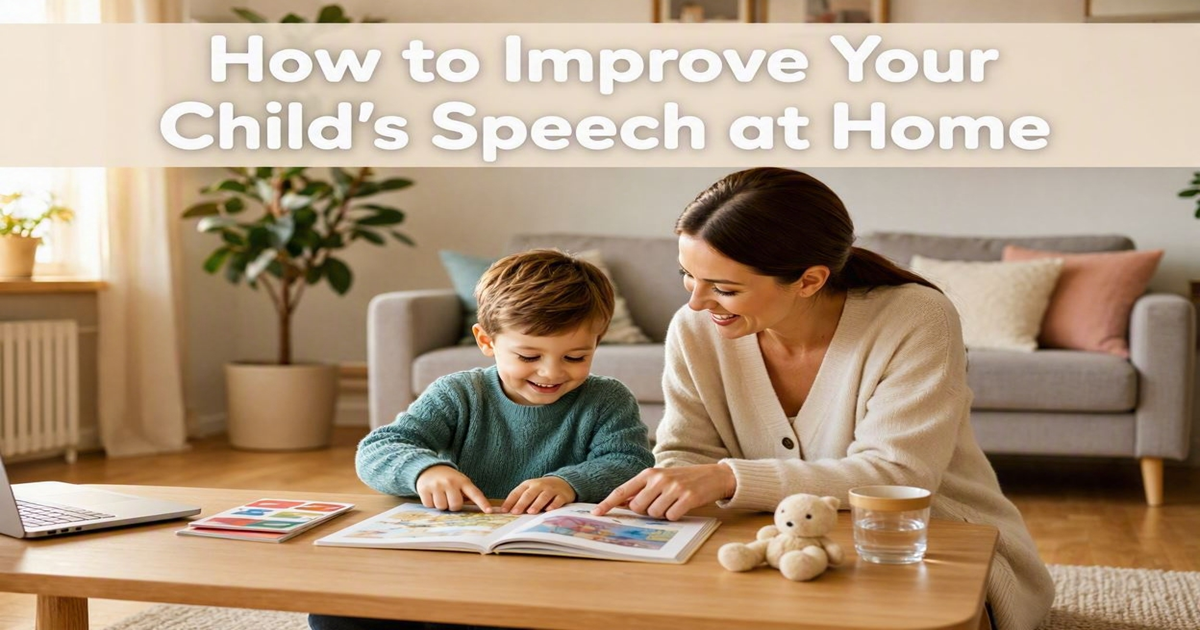
Can you improve your child's speech at home? Yes, everyday conversations, play, reading, songs and simple communication activities can create valuable opportunities for children to practice language and speech.
Parents do not need expensive toys or complicated exercises to encourage communication. Some of the most useful speech and language activities can happen during meals, bath time, playtime, shopping, reading and everyday family conversations.
However, home activities should not be considered a replacement for a professional evaluation when a child has persistent speech or language concerns. A qualified Speech-Language Pathologist (SLP) can help determine what type of support is appropriate.
Why Daily Speech Practice Matters
Children learn communication through repeated interaction. Every time a child listens to a word, tries to imitate a sound, names an object, answers a question or combines words, they are practicing communication.
The goal is not to turn the home into a classroom. Instead, parents can create small opportunities for communication throughout the day.
12 Simple Speech Activities You Can Do at Home
Talk About Everyday Activities
Describe what you and your child are doing.
Examples: "We are washing hands." "The water is running." "Let's open the door."
Repeated exposure to meaningful words helps children connect words with actions and objects.
Follow Your Child's Interests
If your child is playing with a car, talk about the car rather than changing the activity.
Try: "Car!" "Red car." "Car is going." "Fast car!"
Practice Picture Naming
Show your child pictures of familiar objects and encourage them to identify or name them.
Start with familiar words such as: ball, car, dog, cat, apple, cup .
Read Picture Books Together
You do not have to read every sentence. Talk about the pictures and ask simple questions.
"Where is the dog?" "What is this?" "What is the boy doing?"
Use Songs and Rhymes
Songs and nursery rhymes provide repetition, rhythm and opportunities for children to participate.
Pause before a familiar word and allow the child an opportunity to complete it.
Encourage Imitation
Encourage your child to imitate simple sounds, actions and words during play.
Start with easy sounds or words that are appropriate for your child's current ability.
Expand Your Child's Words
If your child says one word, you can model a slightly longer phrase.
Child:
"Ball."
Parent:
"Red ball."
Later:
"Give me the ball."
Give Choices
Instead of asking an open-ended question, give two choices.
Example: "Do you want milk or water?"
This creates a natural reason for the child to communicate a preference.
Play Pretend Games
Pretend play creates opportunities to use vocabulary and simple sentences.
Examples include playing kitchen, shop, doctor, school, vehicles or dolls.
Practice During Mealtimes
Talk about food, colors, tastes, quantities and actions.
Examples: "Apple." "Red apple." "More rice?" "Drink water."
Practice Simple Questions
Ask age-appropriate questions during daily activities.
Examples: "What is this?" "Where is the ball?" "Who is that?"
Give Your Child Time to Respond
After asking a question or modeling a word, pause and give your child time to respond.
Avoid immediately answering every question for your child.
How to Improve Toddler Speech Through Play
Play is one of the easiest ways to encourage communication because it naturally gives children reasons to listen, imitate, request, comment and interact.
Cars & Vehicles
Practice words such as:
car, bus, go, stop, fast, red, bigKitchen Play
Practice:
cup, plate, eat, drink, hot, spoon, moreAnimal Play
Practice:
dog, cat, cow, run, jump, eat, sleepHindi Speech Activities for Children
For children who primarily communicate in Hindi, parents can naturally incorporate Hindi words, sounds and sentences into daily communication.
Children do not need to practice only isolated sounds. Speech and language practice can gradually move from Swar → Shabd → Vakya → Conversation according to the child's communication level.
Swar Abhyas
Practice simple vowel sounds:
अ – आ – इ – ई – उ – ऊ
Encourage listening and imitation in a playful way rather than forcing repeated production.
Shabd Abhyas
Practice familiar words:
पानी – गेंद – घर – दूध – फल – किताब
Picture Identification
Show a picture and ask the child to identify the object.
Example: "यह क्या है?"
Sentence Practice
Gradually expand single words into meaningful sentences.
पानी → पानी चाहिए → मुझे पानी चाहिए।
A Simple 15-Minute Daily Speech Routine
Parents often ask: "How much time should I spend practicing speech with my child?" Instead of one long session, communication opportunities can be spread throughout the day.
Look at 5–10 familiar pictures. Name objects, describe them and encourage your child to participate.
Look at a picture book together. Point, name objects and talk about what is happening.
Follow your child's preferred toy or activity and model simple words and sentences.
Use natural opportunities during meals, dressing, bathing, shopping and family activities.
How to Encourage Your Child to Talk Without Pressure
Parents sometimes unintentionally turn speech practice into repeated questioning:
"What is this?" "Say apple." "Say apple." "What is this?"
Instead, try modeling the word naturally.
For example, while eating an apple:
"Apple!" "Red apple." "Yummy apple."
Then give your child an opportunity to participate.
Model More, Test Less
A useful principle for everyday communication is: model more and test less.
Rather than constantly asking your child to prove that they know a word, demonstrate how the word can be used in a meaningful situation.
What If My Child Does Not Repeat the Word?
Do not assume that your child has failed simply because they do not immediately repeat a word.
Children may need repeated exposure before they begin using a new word. They may also communicate through gestures, sounds, facial expressions or other methods.
Continue modeling language naturally and observe whether communication skills are progressing over time.
Speech Activities for Children With Speech Delay
If your child has an identified speech or language delay, activities should ideally be matched to the child's individual communication level.
For example, a child who is currently communicating mostly with gestures may benefit from different activities than a child who speaks in short sentences but has difficulty producing certain sounds.
Beginning Level
- Eye-catching pictures
- Imitation
- Simple sounds
- Gestures
- Single familiar words
Growing Vocabulary
- Picture naming
- Object identification
- Word combinations
- Simple choices
- Action words
Sentence Level
- Short sentences
- Storytelling
- Questions and answers
- Conversation
- Describing pictures
Can Screen Time Improve Speech?
Parents may wonder whether educational videos or speech apps can automatically improve a child's speech.
Digital resources can provide useful visual and listening practice, but meaningful interaction with parents, caregivers and other people remains an important part of communication development.
If digital activities are used, parents can make them interactive by talking about what the child sees, naming objects and encouraging communication rather than simply allowing passive viewing.
When Home Activities Are Not Enough
Home speech activities can be useful, but parents should seek professional guidance when they have ongoing concerns about their child's communication.
Consider consulting a Speech-Language Pathologist if your child has persistent difficulties with speech, understanding, vocabulary, sentence development, communication or speech clarity.
What Can a Speech Therapist Do?
A Speech-Language Pathologist can assess the child's communication profile and identify areas that may need support.
Depending on the child, therapy may address:
- Speech sound production
- Vocabulary development
- Understanding language
- Sentence development
- Functional communication
- Social communication
- Speech clarity
- Parent-supported home practice
How VaaniSetu Can Support Structured Speech Practice
VaaniSetu.in provides structured digital speech, language and visual practice resources designed to support patients, children, caregivers and Speech-Language Pathologists.
Depending on the child's individual needs and professional guidance, structured activities can support repeated practice with:
- Swar Abhyas
- Shabd Abhyas
- Picture identification
- Word-to-picture association
- Sentence practice
- Visual learning
- Structured home practice
The platform can be used as a digital practice resource alongside appropriate professional guidance.
A Parent's Daily Speech Checklist
Try to create several small communication opportunities every day.
- Did I talk with my child during everyday activities?
- Did I read or look at a picture book together?
- Did I give my child time to respond?
- Did I model words instead of constantly testing?
- Did I follow my child's interests during play?
- Did I encourage gestures and other communication attempts?
- Did I practice a few useful words or phrases?
- Did I make speech practice enjoyable?
7 Things Parents Should Avoid During Speech Practice
1. Avoid Constant Correction
Correcting every sound can make communication stressful. Model the correct word naturally instead.
2. Avoid Comparing Children
Children develop at different rates. Comparing siblings or classmates does not provide an individual assessment of your child's needs.
3. Avoid Forcing Repetition
Encourage communication without turning every interaction into a demand to repeat.
4. Avoid Speaking for Your Child Immediately
Give your child an opportunity to communicate before answering for them.
5. Avoid Making Practice Too Long
Short, enjoyable activities can be easier for young children than lengthy structured sessions.
6. Avoid Focusing Only on Pronunciation
Communication includes understanding, vocabulary, sentence development, gestures and social interaction—not pronunciation alone.
7. Avoid Ignoring Persistent Concerns
If you remain concerned about your child's communication, seek professional guidance rather than relying only on home practice.
Key Takeaways
- Everyday conversations are valuable opportunities for speech and language practice.
- Play, books, songs and picture activities can encourage communication.
- Parents can model words and gradually expand their child's communication.
- Hindi-speaking families can naturally use Hindi words, Swar Abhyas, Shabd Abhyas and sentence practice.
- Give children time to respond and avoid excessive pressure.
- Digital activities can complement meaningful interaction and professional guidance.
- Persistent speech or language concerns should be discussed with a qualified Speech-Language Pathologist.
Make Speech Practice a Part of Everyday Life
Explore structured speech, language and visual practice activities with VaaniSetu.in.
Visit VaaniSetu.inFrequently Asked Questions (FAQ)
1. How can I improve my child's speech at home?
Parents can encourage speech by talking during everyday activities, reading picture books, playing, singing songs, practicing picture naming, modeling words and giving children opportunities to respond. Activities should be appropriate for the child's communication level.
2. What are the best speech activities for toddlers?
Useful activities include picture naming, shared reading, pretend play, songs and rhymes, imitation, simple choices, everyday conversations and gradually expanding the words or phrases a child uses.
3. Can I do speech therapy exercises at home?
Parents can practice communication activities at home, but exercises should ideally be matched to the child's individual needs. When a child has a diagnosed speech or language difficulty, an SLP can provide appropriate home-practice recommendations.
4. How can I encourage my toddler to talk?
Follow your child's interests, talk about what you are doing, model simple words, use gestures, read together, sing songs, give choices and allow your child time to respond.
5. What if my child understands everything but is not talking?
Good understanding can be an encouraging communication sign, but limited spoken language still deserves attention when parents are concerned. An SLP can evaluate expressive language, speech production and other communication skills.
6. Can reading books improve a child's speech?
Shared reading provides opportunities to hear vocabulary, talk about pictures, answer questions and practice communication. Interactive reading—where the parent talks with the child about the story—is especially useful as a communication activity.
7. Are songs and rhymes good for speech development?
Songs and rhymes provide repetition, rhythm and opportunities for children to participate. They can be a fun part of a broader communication routine.
8. Can Hindi activities help improve my child's speech?
Yes. Families can use familiar Hindi words, pictures, songs and everyday conversations to create meaningful communication opportunities. Hindi Swar, Shabd and sentence practice can also be incorporated when appropriate.
9. How long should I practice speech with my child each day?
There is no single amount of time that is appropriate for every child. Short, enjoyable activities can be incorporated throughout the day rather than relying on one long practice session.
10. When should I take my child to a speech therapist?
Consider speaking with a Speech-Language Pathologist if your child has persistent concerns involving speech, vocabulary, understanding, sentence development, communication or speech clarity. If a child loses previously acquired communication skills, professional evaluation should be sought promptly.
11. Can speech delay improve without therapy?
Some children with delayed talking may make significant progress, but it is difficult to predict an individual child's development without considering their complete communication profile. Professional evaluation can help parents understand whether monitoring, home strategies or therapy may be appropriate.
12. Does screen time cause speech delay?
Speech and language development is influenced by multiple factors. Rather than focusing on a single cause, parents should prioritize meaningful interaction, play and communication opportunities and discuss persistent concerns with a healthcare professional.
When to Seek Professional Help
Home activities are an excellent way to create communication opportunities, but they should not delay professional evaluation when concerns persist.
If you are wondering, "How can I improve my child's speech?" the first step is understanding your child's individual communication needs.
A qualified Speech-Language Pathologist can help assess your child's speech and language development and recommend an appropriate plan.