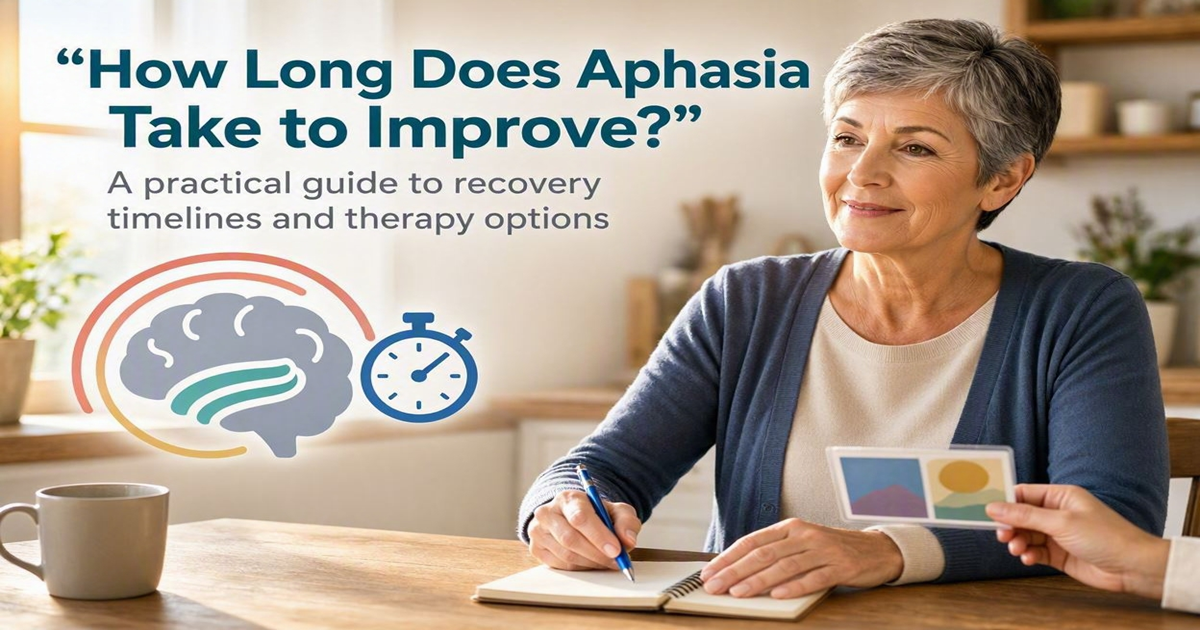
One of the first questions families ask after a stroke is: "How long does aphasia take to improve?"
Aphasia can make it difficult for a person to speak, understand language, find words, read or write. It can be particularly frustrating for stroke survivors and their families because communication difficulties may affect everyday conversations, independence and social participation.
The good news is that communication can improve after stroke. However, aphasia recovery time is different for every person. There is no single number of days, weeks or months that can accurately predict recovery for everyone.
What Is Aphasia After a Stroke?
Aphasia is a language disorder that can occur when stroke damages areas of the brain involved in communication.
It can affect one or more areas of language, including:
- Speaking and expressing thoughts
- Understanding spoken language
- Finding the right words
- Naming objects or people
- Reading
- Writing
- Using or understanding sentences
Aphasia does not necessarily mean that a person has lost their intelligence. In many cases, the person knows what they want to communicate but has difficulty accessing or expressing language.
How Long Does Aphasia Take to Improve After a Stroke?
There is no universal aphasia recovery timeline. Two people with apparently similar strokes can have very different communication outcomes.
A person may experience noticeable improvements in the first few weeks, while another person may continue making gradual progress over many months.
Some stroke survivors continue to develop better communication skills well beyond the early recovery period, particularly when they remain engaged in rehabilitation and regular communication practice.
Aphasia Recovery Timeline: What to Expect
Recovery should be viewed as a process rather than a fixed schedule. The following stages provide a general framework, not a prediction for an individual.
Early Recovery: First Days and Weeks
The early period after stroke can involve significant changes in communication. Medical stabilization, assessment and rehabilitation planning are important during this stage.
First Few Months
Many people experience meaningful changes in communication during the first several months. Speech-language therapy may focus on language comprehension, naming, speaking and functional communication.
Later Recovery
Improvement does not necessarily stop after the early months. Continued therapy and structured communication practice may help people work on remaining difficulties.
Long-Term Communication Practice
Some people benefit from ongoing communication strategies, home exercises, caregiver support and regular opportunities to use language in everyday life.
What Factors Affect Aphasia Recovery Time?
Several factors can influence the course of aphasia recovery after stroke.
1. Location of the Stroke
The area of the brain affected by the stroke can influence which communication abilities are affected.
2. Severity of the Stroke
The size and severity of brain injury can influence the extent of communication difficulties.
3. Type and Severity of Aphasia
Aphasia can affect speaking, comprehension, naming, reading and writing in different ways and to different degrees.
4. Overall Health
General health, fatigue and other effects of stroke can influence participation in rehabilitation.
5. Rehabilitation
Assessment and individualized speech-language rehabilitation can help identify appropriate communication goals.
6. Communication Practice
Meaningful opportunities to use language can help reinforce communication skills as part of a broader rehabilitation plan.
Does Speech Therapy Help Aphasia After Stroke?
Speech-language therapy is an important component of aphasia rehabilitation.
A Speech-Language Pathologist (SLP) can assess the person's communication abilities and identify appropriate therapy goals.
Depending on the individual's needs, therapy may address:
- Word finding
- Object and picture naming
- Language comprehension
- Sentence formation
- Conversation skills
- Reading
- Writing
- Functional communication
Can Aphasia Exercises Be Done at Home?
Yes. Home practice can provide additional opportunities to practice communication skills between professional therapy sessions.
However, the exercises should be appropriate for the person's abilities. An activity that is useful for one person may be too difficult or may not address the primary communication problem of another person.
Examples of Aphasia Exercises at Home
- Picture Naming: Identify familiar objects shown in pictures.
- Word-to-Picture Matching: Match a word with the correct image.
- Word Retrieval: Practice retrieving commonly used words.
- Sentence Completion: Complete simple, meaningful sentences.
- Reading Practice: Read familiar words or short sentences when appropriate.
- Functional Conversation: Practice talking about familiar people, activities and needs.
Hindi Aphasia Exercises After Stroke
For Hindi-speaking stroke survivors, communication rehabilitation can include meaningful Hindi words and sentences used in everyday life.
Hindi practice can include:
- Hindi Swar Abhyas
- Familiar Hindi word practice
- Picture identification
- Word-to-photo association
- Hindi sentence practice
- Functional conversation
Does Aphasia Recovery Stop After 6 Months?
No. The idea that recovery must stop at a specific time point can create unnecessary discouragement.
Although recovery patterns can change over time, communication improvement may continue beyond the early months. Some people continue to benefit from rehabilitation, structured practice and communication strategies for a prolonged period.
The pace of improvement may become slower, but slower progress is not necessarily the same as no progress.
How Family Members Can Help Aphasia Recovery
Family members can make everyday communication more supportive by creating opportunities for the stroke survivor to participate in conversations.
- Give the person enough time to respond.
- Avoid completing every sentence for them.
- Use gestures, pictures or writing when helpful.
- Ask simple questions when communication is difficult.
- Focus on the message rather than perfect grammar.
- Encourage communication attempts.
- Practice meaningful words used in everyday life.
- Follow the communication strategies recommended by the SLP.
How VaaniSetu Supports Hindi Speech Practice
VaaniSetu provides structured digital practice designed to support Hindi communication exercises for patients, caregivers and clinicians.
Depending on the exercise package created for the user, practice may include:
- Swar Abhyas
- Shabd Abhyas
- Sentence Practice
- Photo Identification
- Word-to-Photo Association
- Melodic and rhythm-based practice
- Structured exercise packages
- Practice and attempt tracking
For Speech-Language Pathologists, structured digital exercises can also help organize home practice as part of an individualized rehabilitation program.
Support Communication. Practice Every Day.
Explore structured Hindi speech and language practice with VaaniSetu and make communication practice a regular part of rehabilitation.
Visit VaaniSetu.inWhen Should You See a Speech-Language Pathologist?
If a person continues to have difficulty speaking, understanding language, finding words, reading or writing after a stroke, professional assessment can help determine the nature and severity of the communication disorder.
An SLP can evaluate communication abilities and develop an individualized rehabilitation plan based on the person's goals, strengths and difficulties.
Can Aphasia Be Completely Cured After a Stroke?
There is no reliable way to predict complete recovery for an individual person.
Some people may recover communication abilities very well, while others may continue to experience aphasia but develop effective strategies for communicating their needs and ideas.
Therefore, the goal of rehabilitation is not always simply eliminating every symptom. It can also include improving functional communication, independence, participation and confidence.
If a person suddenly develops new or worsening difficulty speaking or understanding speech, facial weakness, arm or leg weakness, confusion, severe dizziness or other sudden neurological symptoms, seek emergency medical attention immediately. Sudden symptoms may indicate another stroke or other medical emergency.
Key Takeaways
- Aphasia recovery time varies significantly from person to person.
- Many people experience important changes during the early stages following stroke.
- Aphasia recovery can continue beyond the first few months.
- Speech-language therapy can address speaking, comprehension, word finding, reading, writing and functional communication.
- Appropriate aphasia exercises at home can complement professional rehabilitation.
- Hindi-speaking individuals can benefit from meaningful Hindi communication practice.
- Family members can support recovery by encouraging communication and allowing enough time for responses.
- There is no universal deadline by which aphasia recovery must be complete.
Frequently Asked Questions
How long does aphasia take to improve after a stroke?
Aphasia recovery varies greatly. Many people experience noticeable changes during the early weeks and months, but improvement can continue for months or longer.
How long does aphasia last after a stroke?
There is no fixed duration. Some people recover significantly, while others continue to have aphasia but develop better communication abilities and strategies over time.
Can aphasia go away completely?
Complete recovery is possible for some people, but it cannot be guaranteed or predicted for an individual. Rehabilitation can support communication recovery and functional independence.
Does speech therapy help aphasia after stroke?
Speech-language therapy is an important part of aphasia rehabilitation. Therapy goals are individualized and may include speaking, word finding, comprehension, reading, writing and conversation.
Can aphasia exercises be done at home?
Yes. Appropriate exercises can often be practiced at home as part of an individualized plan recommended by a Speech-Language Pathologist.
Does aphasia recovery stop after six months?
Not necessarily. Although the rate of recovery can change, people may continue to make communication gains beyond the early months through rehabilitation and meaningful practice.
Are Hindi speech exercises useful after stroke?
Hindi speech and language exercises can make communication practice more meaningful for Hindi-speaking individuals, particularly when the activities reflect their everyday communication needs.
This article is provided for educational and informational purposes only. It is not a substitute for medical diagnosis, professional speech-language assessment or individualized treatment. Aphasia recovery differs between individuals. Stroke survivors should consult an appropriately qualified healthcare professional or Speech-Language Pathologist for personalized assessment and rehabilitation. Do not start, stop or modify treatment based solely on information in this article.