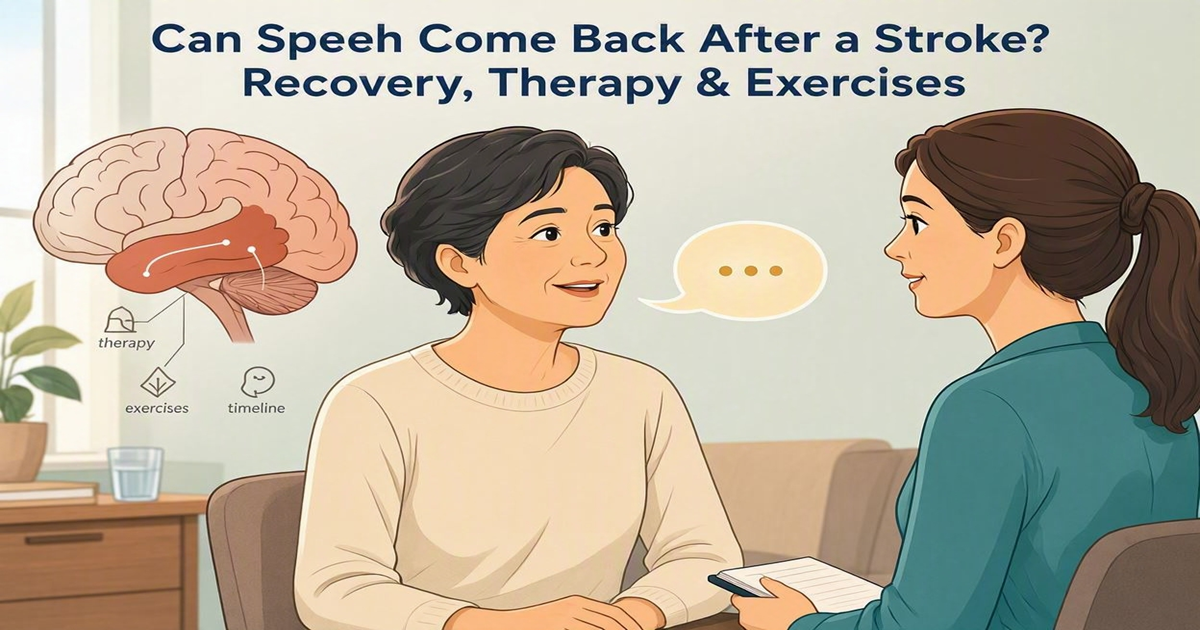
One of the most difficult moments for a family can be seeing a loved one unable to speak normally after a stroke. A person who previously communicated easily may suddenly struggle to find words, speak clearly, understand questions or form sentences.
This often leads families to ask an important question: "Can speech come back after a stroke?"
Why Does a Stroke Affect Speech?
A stroke occurs when blood flow to part of the brain is interrupted or when bleeding damages brain tissue. If areas involved in language, speech planning or speech movement are affected, communication may change.
The resulting speech problems after stroke can therefore look very different from one person to another.
Some people may understand everything but cannot find the words. Others may know exactly what they want to say but their speech sounds slurred or difficult to understand.
Some people may also have difficulty planning the precise movements needed to produce speech sounds.
What Kind of Speech Problems Can Happen After a Stroke?
Aphasia
Aphasia primarily affects language.
It can affect speaking, word finding, understanding, reading and writing.
Dysarthria
Dysarthria primarily affects the physical production of speech.
Speech may sound weak, slow, slurred or unclear.
Apraxia of Speech
Apraxia can affect the planning and coordination of speech movements.
Speech may become effortful or contain inconsistent sound errors.
A stroke survivor may experience one of these conditions or a combination of them. This is one reason why a professional communication assessment is important.
Can Speech Come Back After a Stroke?
Yes. Many people experience improvement in communication following a stroke.
The extent of speech recovery after stroke varies considerably. Recovery may involve regaining some previously lost abilities, improving existing abilities or learning alternative communication strategies.
Improvement may occur at different rates and can continue over time. There is no universal recovery schedule that applies to every stroke survivor.
Early Recovery
Some people experience noticeable changes during the early stages following stroke as the brain and body begin the rehabilitation process.
Ongoing Rehabilitation
Structured rehabilitation can provide opportunities to work on communication skills and functional goals.
Long-Term Practice
Some individuals continue communication practice for an extended period depending on their needs and goals.
What Affects Speech Recovery After Stroke?
Several factors can influence communication recovery. These may include:
- Location of the brain injury
- Severity and type of stroke
- Type of communication disorder
- Overall health and medical condition
- Cognitive and neurological factors
- Participation in rehabilitation
- Individual communication goals
- Support from family and communication partners
How Does Speech Therapy Help After a Stroke?
Speech therapy after stroke is usually individualized according to the person's communication difficulties and rehabilitation goals.
A Speech-Language Pathologist (SLP) may assess areas such as language, speech production, comprehension, reading, writing and functional communication.
Depending on the person's needs, therapy may focus on:
- Word retrieval and naming
- Speech sound production
- Sentence formation
- Speech clarity
- Speech rate and coordination
- Understanding spoken language
- Reading and writing
- Functional everyday communication
Speech Exercises After Stroke
The right exercises depend on whether the person has aphasia, dysarthria, apraxia or another communication difficulty.
Examples of structured activities that may be incorporated into an individualized rehabilitation plan include:
Sound Practice
Practicing selected speech sounds or sound combinations according to the individual's speech-language goals.
Word Practice
Repeated practice of meaningful words can support structured language and speech activities.
Picture Identification
Pictures can be used for naming, identification and word-to-picture association activities.
Sentence Practice
Structured sentence activities can help practice functional communication.
Repetition Practice
Repetition can be incorporated into rehabilitation activities according to the person's therapy plan.
Functional Communication
Practice can focus on useful words, phrases and communication situations from everyday life.
Can Speech Exercises Be Done at Home?
In many rehabilitation programs, appropriate home practice can complement professional therapy.
The activities should be selected according to the person's communication needs and the recommendations of their SLP.
A useful home practice routine may involve short, structured sessions rather than trying to practice everything at once.
A Simple Practice Routine
- Start with a small number of familiar sounds or words.
- Practice slowly and clearly.
- Use pictures or written cues when appropriate.
- Repeat selected words or phrases according to the therapy plan.
- Include meaningful everyday communication.
- Record progress or practice attempts when recommended by the SLP.
Hindi Speech Therapy and Speech Recovery After Stroke
For many Indian families, communication happens primarily in Hindi or another regional language. Therefore, rehabilitation may need to consider the language that the person actually uses in everyday life.
Hindi speech therapy and structured Hindi practice may include activities involving:
- Hindi Swar practice
- Hindi word practice
- Picture identification
- Word-to-photo association
- Hindi sentence practice
- Functional Hindi communication
The activities should be individualized based on the person's assessment, preferred language and rehabilitation goals.
Can Melodic Intonation Therapy Help Speech Recovery?
Melodic Intonation Therapy (MIT) is a structured approach that uses elements such as melody, rhythm and intonation to support speech production in selected people with aphasia.
Research has studied MIT particularly in people with non-fluent aphasia. It may help some aspects of expressive language and repetition, but it is not appropriate for everyone and should not be considered a universal solution.
An SLP can determine whether MIT or another speech-language approach is appropriate for an individual.
How Family Members Can Help Speech Recovery
Family members can play an important role in creating a supportive communication environment.
Give Enough Time
Allow the person time to find words and respond. Avoid rushing to finish every sentence.
Reduce Distractions
Reduce background noise and distractions when having important conversations.
Use Multiple Ways to Communicate
Gestures, writing, pictures or other communication supports may be useful when appropriate.
Encourage Attempts
Focus on communicating the message rather than expecting perfect speech every time.
How VaaniSetu Can Support Speech Practice
VaaniSetu is designed to support structured Hindi speech and communication practice through digital exercises.
Practice Areas on VaaniSetu
- Hindi Swar Abhyas
- Word practice
- Sentence practice
- Melodic Intonation exercises
- Photo identification exercises
- Word-to-photo association
- Structured exercise packages
- Practice and progress tracking
VaaniSetu can be used to support structured practice alongside professional speech-language rehabilitation where appropriate.
It is not a replacement for medical care, neurological evaluation, professional SLP assessment or an individualized treatment plan.
When Should You See a Speech-Language Pathologist?
If a person develops communication difficulties following a stroke, professional assessment should be considered.
An SLP can help identify whether the main difficulty involves language, speech production, speech planning or a combination of communication problems.
Professional guidance is particularly important when communication difficulties are severe, changing or affecting everyday activities.
Key Takeaways
- Speech can improve after a stroke, but recovery varies from person to person.
- Aphasia, dysarthria and apraxia are different communication disorders.
- Speech-language therapy can support communication rehabilitation.
- Home practice can complement professional therapy when appropriately planned.
- Hindi and other familiar languages can be considered when planning meaningful communication practice.
- Consistency, realistic goals and family support can be valuable parts of rehabilitation.
- A qualified SLP should guide an individualized communication rehabilitation program.
Frequently Asked Questions
Can speech come back after a stroke?
Yes. Many stroke survivors experience improvement in speech or language abilities. The amount and speed of recovery vary depending on individual factors.
How long does it take to recover speech after a stroke?
There is no single recovery timeline. Some people improve relatively quickly while others continue to make progress over a longer period.
Can speech therapy help after a stroke?
Yes. Speech-language therapy can support communication rehabilitation and help individuals work toward functional communication goals.
What are the best speech exercises after a stroke?
Exercises depend on the individual's communication difficulties. They may include sound, word, naming, comprehension, sentence, reading and structured repetition activities.
Can Hindi speech practice help after a stroke?
For Hindi-speaking individuals, meaningful Hindi sounds, words and sentences can be incorporated into an individualized rehabilitation program.
Can aphasia improve after a stroke?
Aphasia can improve after stroke, although recovery differs between individuals. Speech-language rehabilitation can support language and communication recovery.
Start Structured Speech Practice With VaaniSetu
Explore Hindi speech and communication exercises designed to support structured practice and rehabilitation alongside professional guidance.
Visit VaaniSetu.inThis article is intended for general educational and informational purposes only. It is not a substitute for medical diagnosis, neurological evaluation, professional speech-language assessment or individualized treatment. If someone develops sudden difficulty speaking, facial drooping, weakness, confusion or other possible signs of stroke, seek emergency medical care immediately.