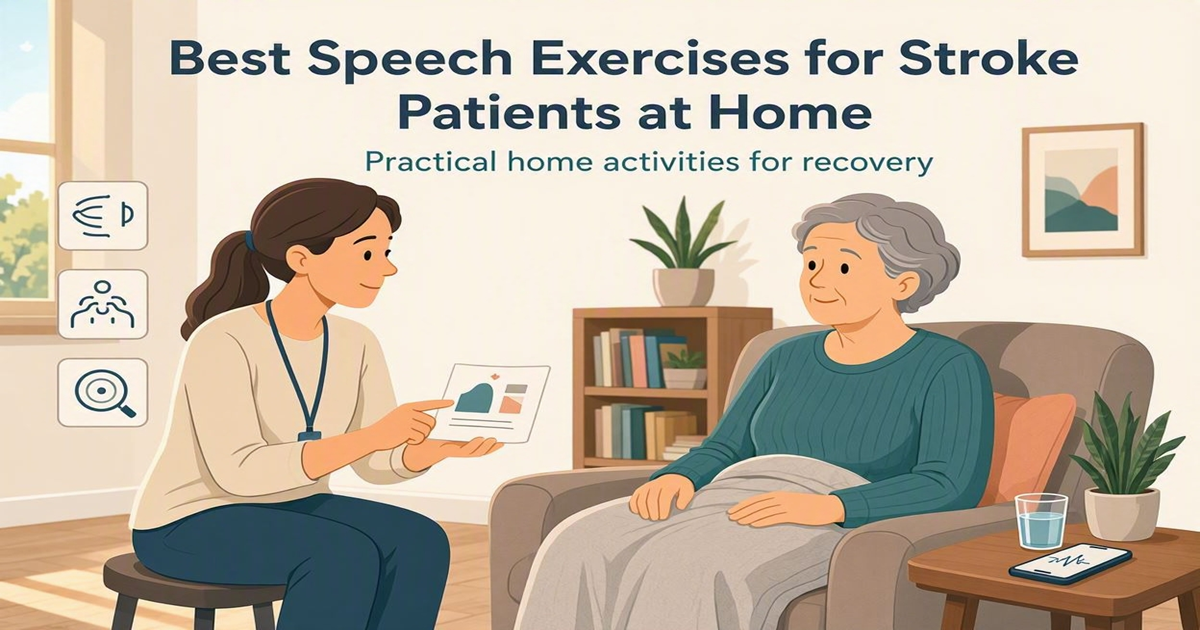
Speech and communication difficulties are common after a stroke. Some people may have difficulty finding words, while others may struggle with pronunciation, speech clarity, understanding language or coordinating the movements required for speaking.
Regular rehabilitation can play an important role in communication recovery. Along with professional speech therapy, appropriately selected speech exercises after stroke can often be practiced at home to provide additional opportunities for structured communication practice.
Why Is Speech Difficult After a Stroke?
A stroke can affect areas of the brain involved in language, speech production, memory, attention and motor control. The resulting communication problem can therefore look very different from one person to another.
Aphasia
Aphasia can affect the ability to understand or express language. A person may know what they want to say but have difficulty finding the right word, forming sentences, naming objects or understanding spoken language.
Dysarthria
Dysarthria is primarily a motor speech disorder. Weakness or reduced coordination of the muscles involved in speech can make speech sound slow, soft, unclear or difficult to understand.
Apraxia of Speech
Apraxia of speech can make it difficult to plan and coordinate the movements needed for speaking. A person may produce a word differently from one attempt to another or struggle to initiate particular speech sounds.
Can Speech Exercises Help Stroke Speech Recovery?
Structured practice can provide repeated opportunities to work on specific communication skills. However, there is no single exercise that works for every stroke survivor.
Stroke speech recovery varies from person to person. Factors such as the location and severity of the stroke, communication disorder, general health, motivation, therapy participation and individual response to rehabilitation can all influence progress.
The goal of home practice is not simply to make a person repeat words. Exercises should target meaningful communication skills and should be adjusted as the person's abilities change.
Best Speech Exercises After Stroke
Breathing and Voice Practice
Controlled breathing and gentle voice practice may help a person prepare for speech activities.
Try producing a comfortable sustained vowel such as "aa" for a few seconds, without forcing the voice.
Vowel and Sound Repetition
Practice simple sounds or vowels repeatedly when appropriate for the person's communication goals.
Examples include: अ, आ, इ, ई, उ, ऊ for Hindi-speaking individuals.
Single-Word Practice
Start with familiar and meaningful words such as names of family members, food items, household objects or commonly used actions.
Repetition should be slow and comfortable rather than rushed.
Picture Naming
Show a familiar picture and ask the person to identify or name it.
If naming is difficult, provide a meaningful cue or allow the person to point to the correct picture.
Word-to-Picture Matching
Matching written or spoken words with pictures can provide structured language practice.
Begin with a small number of familiar options and gradually increase difficulty as appropriate.
Reading Aloud
For people who are able to read, short familiar words or sentences may be practiced aloud.
Start with easy material and focus on accuracy, clarity and confidence rather than speed.
Sentence Practice
Practice short functional sentences related to daily life.
Examples:
"मुझे पानी चाहिए।"
"मैं खाना खाऊँगा।"
"मुझे घर जाना है।"
Functional Conversation
Practice real-life communication instead of focusing only on isolated sounds or words.
Talk about family, food, daily activities, hobbies, photographs or familiar places.
Speech Therapy Exercises at Home: Start Simple
One of the most important principles of home practice is consistency. A short, structured practice session may be easier to manage than a long session that causes excessive fatigue or frustration.
A Simple Home Practice Routine
- Choose a quiet environment with minimal distractions.
- Begin with a short warm-up.
- Practice a small number of targeted sounds or words.
- Move from simple tasks toward more functional communication.
- Give the person enough time to respond.
- Provide encouragement instead of repeatedly correcting mistakes.
- Stop or take a break if the person becomes significantly tired.
Hindi Speech Exercises After Stroke
For Hindi-speaking stroke survivors, practicing communication in Hindi can make exercises more relevant to everyday conversations. Depending on the individual's abilities, practice can include Swar Abhyas, Shabd Abhyas and Sentence Practice.
Swar Abhyas
Practice selected Hindi vowel sounds and combinations according to the person's therapy plan.
Shabd Abhyas
Practice familiar Hindi words connected with everyday needs, family members, objects and activities.
Vakya Abhyas
Progress from individual words to short functional Hindi sentences when appropriate.
Melodic Intonation and Rhythm-Based Practice
Some people with non-fluent aphasia may benefit from structured approaches that use elements of melody, rhythm and intonation. Melodic Intonation Therapy (MIT) is a specialized approach that should be applied appropriately and does not replace a complete speech-language assessment.
Rhythm and structured repetition can also make practice easier to follow for some individuals. The exact approach should be selected according to the person's communication profile and therapy goals.
Speech Exercises for Dysarthria After Stroke
People with dysarthria may have reduced speech clarity because of weakness or impaired coordination of the muscles involved in speaking.
Depending on the individual's assessment, therapy may address areas such as speech rate, loudness, articulation, breath support and overall intelligibility.
Dysarthria exercises should not be treated as a generic list of mouth movements. A Speech-Language Pathologist can determine which strategies are appropriate for the individual.
Speech Therapy Exercises for Aphasia
Aphasia exercises generally focus on language rather than simply strengthening the mouth.
Depending on the type of aphasia, practice may include:
- Object and picture naming
- Word comprehension
- Word-to-picture matching
- Following simple instructions
- Word retrieval practice
- Sentence completion
- Reading and writing activities
- Functional conversation
How Family Members Can Support Stroke Speech Recovery
Family members and caregivers can have an important role in creating opportunities for communication practice.
- Give the person enough time to respond.
- Avoid finishing every sentence for them.
- Use pictures, gestures or written words when helpful.
- Keep conversations focused and simple when necessary.
- Celebrate successful communication attempts.
- Practice meaningful words used in everyday life.
- Follow the exercise plan provided by the SLP.
How VaaniSetu Can Support Home Speech Practice
VaaniSetu is designed to provide structured Hindi speech practice and digital exercises that can complement professional rehabilitation.
Depending on the exercise package created by the clinician, users can practice activities such as:
- Hindi Swar Abhyas
- Word practice
- Sentence practice
- Photo identification
- Word-to-photo association
- Melodic and rhythm-based practice
- Structured exercise packages
- Practice and attempt tracking
For Speech-Language Pathologists, structured digital practice can help organize exercises and monitor patient participation as part of a broader rehabilitation plan.
Practice Speech. Build Confidence. Communicate Better.
Explore structured Hindi speech practice and rehabilitation exercises with VaaniSetu.
Visit VaaniSetu.inWhen Should You Consult a Speech-Language Pathologist?
Professional assessment is particularly important when a person has persistent communication difficulties after stroke.
An SLP can identify the nature of the communication disorder and develop an individualized rehabilitation plan. This is especially important when the person has difficulty understanding language, severe speech impairment, suspected apraxia, significant dysarthria or difficulty communicating basic needs.
If speech suddenly becomes worse or a person develops sudden facial weakness, arm or leg weakness, confusion, severe dizziness or difficulty speaking, treat it as a possible medical emergency and seek emergency medical care immediately.
Key Takeaways
- Speech exercises after stroke can provide structured opportunities for communication practice.
- Exercises should match the person's specific communication difficulty.
- Aphasia, dysarthria and apraxia require different therapeutic approaches.
- Consistent and meaningful speech therapy exercises at home may complement professional therapy.
- Hindi-speaking individuals can practice meaningful Hindi sounds, words and sentences.
- Family involvement and patience can make communication practice more supportive.
- Professional assessment by a Speech-Language Pathologist is important for individualized rehabilitation.
Frequently Asked Questions
What are the best speech exercises after stroke?
Depending on the person's condition, useful exercises may include sound repetition, word practice, picture naming, word-to-picture matching, reading aloud and functional sentence practice.
Can stroke patients do speech therapy exercises at home?
Yes. Many speech and language activities can be practiced at home. Ideally, exercises should be selected or reviewed by a qualified Speech-Language Pathologist.
How often should speech exercises be practiced after stroke?
Practice frequency depends on the individual's condition, therapy plan and tolerance. Consistent practice is generally more practical than occasional very long sessions.
Can speech return after a stroke?
Communication can improve after stroke, but the amount and speed of recovery varies widely. Rehabilitation and regular practice can support recovery for many people.
Are Hindi speech exercises useful after stroke?
Hindi speech practice can be useful for Hindi-speaking individuals because it allows them to practice meaningful communication in a language they commonly use.
This article is intended for educational and informational purposes only. It is not a substitute for medical diagnosis, speech-language assessment or individualized treatment. Stroke survivors should consult an appropriately qualified healthcare professional or Speech-Language Pathologist for personalized advice. Do not start, stop or modify treatment based solely on information in this article.